Re-animating the Monumental Spirit of Solidarity of the Paris Commune From Tunis to Réunion Island
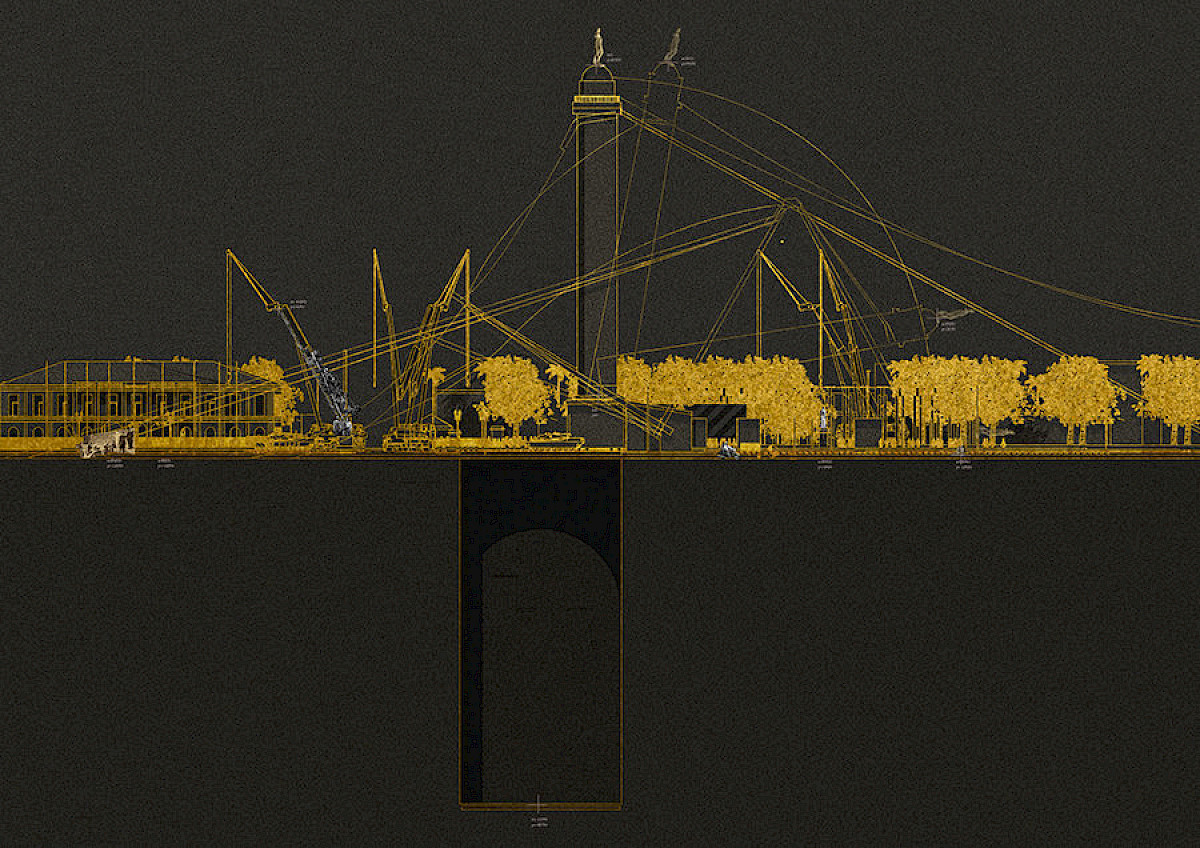
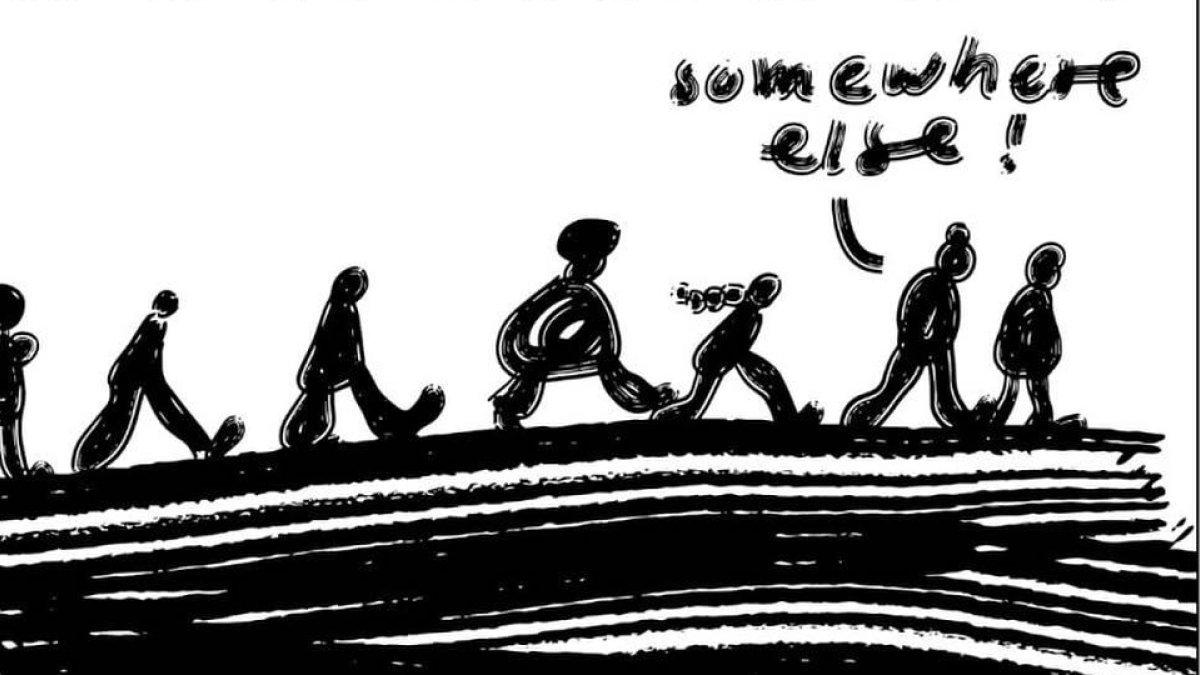
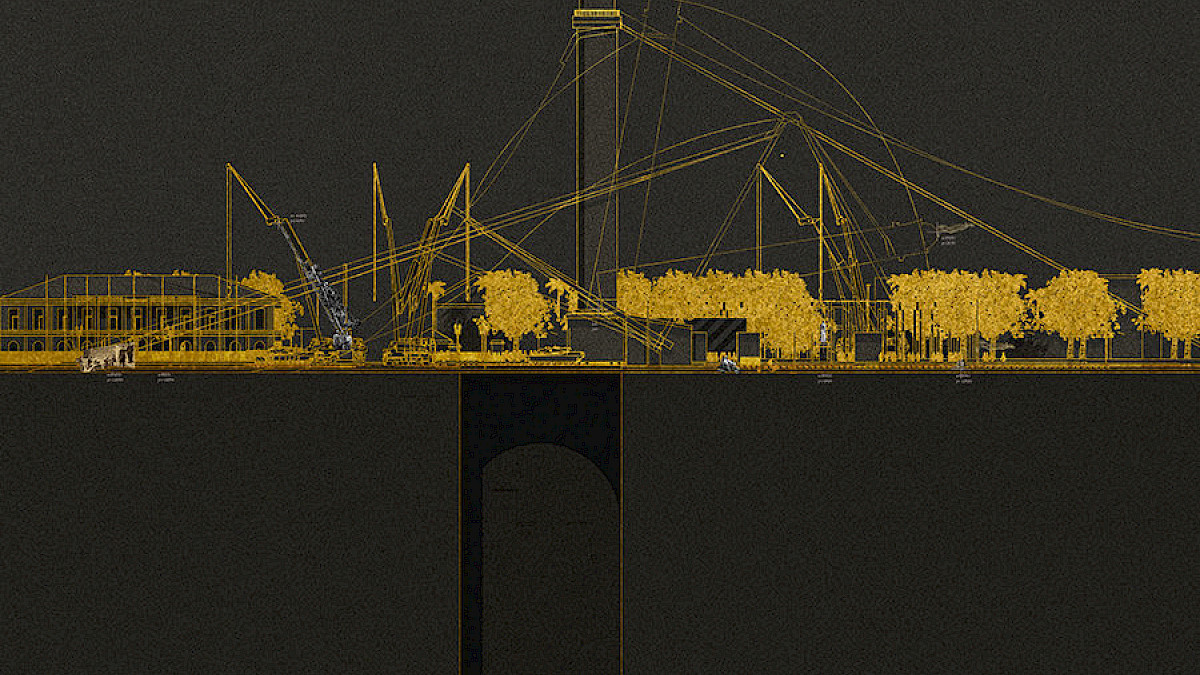
The Vendome Column is buried in Saint-Denis, La Réunion (from The Twin Transcripts, 2018 by Roanne Moodley)
télécharger le PDF The Funambulist #34

In the wake of a plethora of colonial and imperial monument ceremonialized destructions, the demolition of the Vendôme Column by the Paris Commune appears as paradigmatic. Joachim Ben Yakoub reflects on this key event, and on three recent artworks inspired by it.

In 2021, we are not only commemorating 150 years of the Paris Commune, but also 10 years of re-emerging planetary revolts. In the same way the story of Communards cannot properly be told without mentioning the fall of the Vendôme Column, the tale of the most recent upsurges of revolt cannot properly be told without mentioning the intensification of what Bhakti Shringarpure called a “rage against monuments” (Warscapes, 2012). An archipelago of decolonial rage is spontaneously bursting out worldwide, targeting public statues that until today glorify the legacy of slavery, imperialism and colonization. From the settler colonial states of South Africa, the U.S., Canada, New Zealand, and Australia to the heart of the Empire in France, Belgium, and England, recent protests broke the polis in two. The national heroes sculpted in bronze revered by some, seem to represent contempt, injustice, oppression and clear cut genocide for others, rendering visible a deep societal antagonism, going beyond the classical “left-right” binary opposition.

It is in this light paramount to question, what is still left of the left and how to reconstruct from this monumental debris new caring forms of planetary alliances, solidarities that could prefigure new ways of inhabiting the world in freedom and dignity. As we will see, finding answers to this urgent question will require a decisive dose of what Houria Bouteldja calls “revolutionary love” (2016). To understand what is at stake when implicitly criticizing the coloniality of the left, we will look at the various ways present-day visual artists are returning to the orchestrated fall of the Column exalting Napoleonic imperialism during the Paris Commune, rearticulating international solidarity into possible forms of translocal solidarity. We will do so by speaking nearby Édouard Glissant, as he recurrently stated that each one of us needs the memory of the other in the lucid process of what he called Relation, or in his own words “if we want to share the beauty of the world, if we want to be in solidarity with its sufferings, we must learn to remember together” (Une nouvelle région du monde, 2006).

But let us first start by contrasting the internationalist spirit of the Paris Commune with a very sharp but loving critique by one of the main political philosophers of the anti-colonial struggle: Frantz Fanon. After the Vendôme Column was toppled in Paris in May 1871, official Communards cheerfully announced the celebrating crowd “Vendôme Square”will henceforth be named “International Square.” This short lived toponymic reversal marked a rupture from the inheritance of the French Revolution towards a real working-class internationalism. As reminded by Kristin Ross in her remarkable book Communal Luxury (2015), according to Communard Benoît Malon, the destruction of the Vendôme Column fundamentally questioned the supposed inevitability of imperial wars. It promoted a spirit of anti-nationalism and international fraternity. The Paris Commune was more apt to relate to an international constellation of insurgency than to a nationalist imaginary, including the Indian revolt against British racial capitalism, the uprisings during Black Reconstruction in North America, rebellions in Ireland, Hungary, Poland, and the freedom struggle of the serfs in Russia, or the simultaneous Kabyle uprising in Algeria.

Let us also not forget that the combative words of L’Internationale were initially written during the bloody executions of the overpowered Communards by influential poet, transport worker and founding member of the Artists’ Federation, Eugène Pottier. Communard Pottier indeed wrote the poem L’Internationale, which became the International Workingmen’s Association hymn before it was adopted by the Second International as its official anthem and consequently translated and chanted in many different languages. Almost 100 years later, Fanon adopted the by then famed first line of ‘The Internationale’ as the title of his ground-breaking book Les Damnés de la Terre (The Wretched of the Earth) as a sharp but loving gesture, critiquing the universalist pretenses of the European working class movements. From its onset the labor movement encountered difficulties to relate to different slave revolts overseas, but also to the anti-colonial and anti-imperialist movements, and the following planetary wave of decolonial revolts. When Fanon, proposed to turn our back to Europe, he proposed to also turn our back to the European working class and its self-proclaimed internationalism, as he said: “in general, the workers of Europe have not replied to these calls; for the workers believe, too, that they are part of the prodigious adventure of the European spirit.”

Despite its historical longevity and the countless reiterations of this Fanonian critique, different present-day visual artists are revisiting the orchestrated fall of the imperial Column during the Paris Commune, all the while reanimating its internationalist spirit. South African architect Roanne Moodley, U.S. historian and architect David Gissen, and Tunisian artist Nidhal Chamekh, excavate, each in their own way, the fall of the Vendôme Column so central in the storytelling of the Paris Commune, all along connecting this event to its imperial and colonial reverse tracing routes to the African continent, more specifically the Maghreb in general, Tunisia in particular, as well as Réunion island. Following the routes of these three artists, an impression will be drawn of what Glissant called a Tout-Monde, relating different temporalities across continents in the subversion of a shared modernist monumental landscape.

In what follows the attempts to overthrow the Vendôme Column by the Communards in 1871 in Paris, the Novemberist Clock Tower in Tunis in 2011, and the Victory Column in Réunion will therefore be excavated from the perspective of radical simultaneity. This perspective of coevalness preempts anachronistic comparisons underpinning the bigoted idea that Arabs, Blacks, Imazighen, Creole, Muslims, and Maroons would be late or backward, and are only now catching up with the train of History. It is indispensable to underline, that while France lost the 1870-1871 war with Prussia and the Communards were fighting the bourgeois in Paris, the massive Mokrani Revolt against the French colonial project was gaining momentum in Algeria and people were resisting colonial competition between France, England, and Italy, as they all wished to settle in Tunisia. It is also key to emphasize that, while Tunisians were revolting against the postcolonial authoritarian regime of Ben Ali, they were revolting against a regime economically and politically fully supported by a still very imperialist French government. It is equally vital to remember, that while in 2011 Tunisia, the people were demanding to overthrow the regime, in France the masses also occupied the squares, stood up day and night with the workers in yellow vests against neo-liberal austerity, together with a resurgence of anti-racism activism against police violence. Let us not forget either that Réunion island, together with Guadeloupe, Guiana, Martinique, and Mayotte, is today still a so-called “overseas department” and “prefecture” of the French Republic. Even if the current French president stated that the Republic will not erase any trace or name from its history, nor unbolt any of its statue, two statues of French politician Victor Schœlcher and the already beheaded statue of Napoléon’s wife, Empress Joséphine de Beauharnais were recently toppled in Martinique. While those of Colbert, Gallieni, Bugeaud, Faidherbe, or Mangin were contested in France, people in Réunion were simultaneously trying to get rid of their statue of François Mahé de La Bourdonnais. Nobody could prevent the planetary puncturing of the prevailing consent of a shared history of slavery, colonialism and racism.

Retracing a planetary constellation of decolonial rage as an answer to the slow degeneration of the contemporary white neoliberal world, suggests a deep engagement with the political possibility of what Houria Bouteldja following Chela Sandoval, calls “revolutionary love.” It is from the possibility of revolutionary love that political differences between the debris of the left and a new emerging decolonial constituency can be transcended. From this possibility, it is imaginable to remember both the recent decade of revolt, together with the sesquicentennial of the Paris Commune. Desirable solidarities between what is left of the left after it is broken in two and what is spontaneously emerging from the backdoor of history of decolonization are reshaping our understanding of intersectionality. Re-animating the spirit of the Combahee River Collective and as repeatedly underlined by Angela Davis, the meaning of intersectionality shifts from an intricate understanding of layered forms of oppression, to the necessity of incessant labor on the intersections of a shared struggle against various intersecting racial capitalist formations, symbolized by the fall of upright phallic monuments. In the light of revolutionary love, intersecting oppressions transform into intersecting struggles. Overthinking the constructive side of the anticipated destruction of these monuments and incessantly asking questions while walking, are then the conditions of possibility to see one of the many possible ways towards another more sustainable and just world, towards a world in which many worlds fit.

The Twin Transcripts by Roanne Moodley ///

Moodley Funambulist
The Vendome Column is buried in Saint-Denis, La Réunion. / Artwork from The Twin Transcripts (2018) by Roanne Moodley.

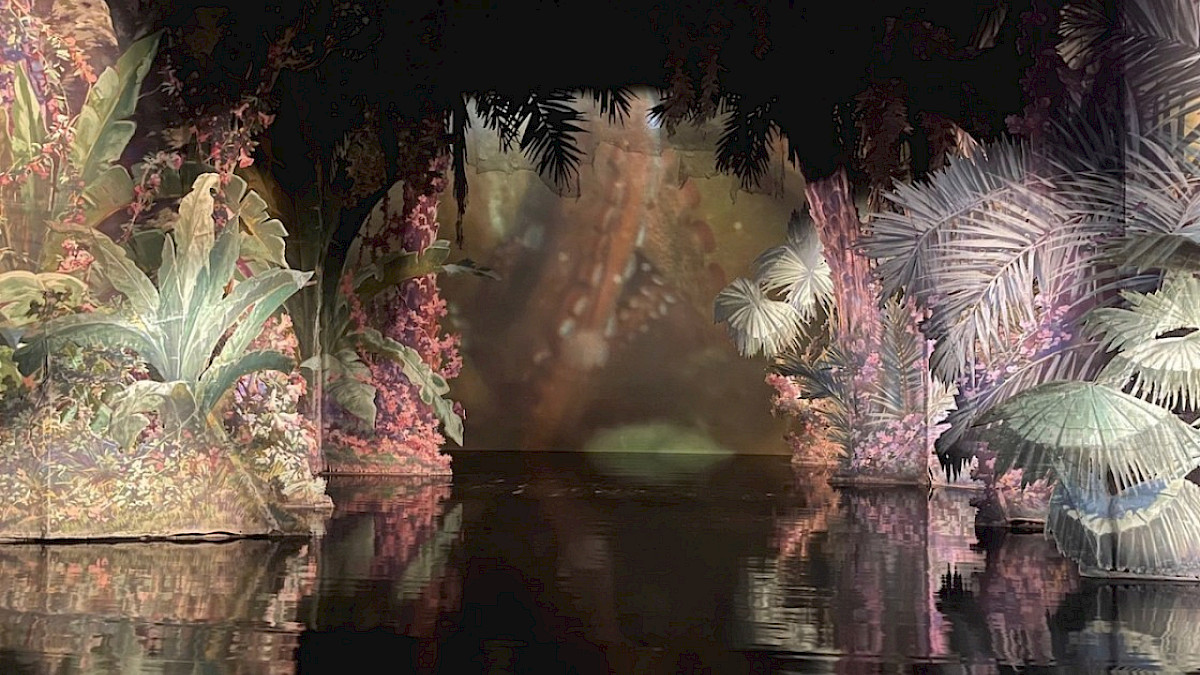
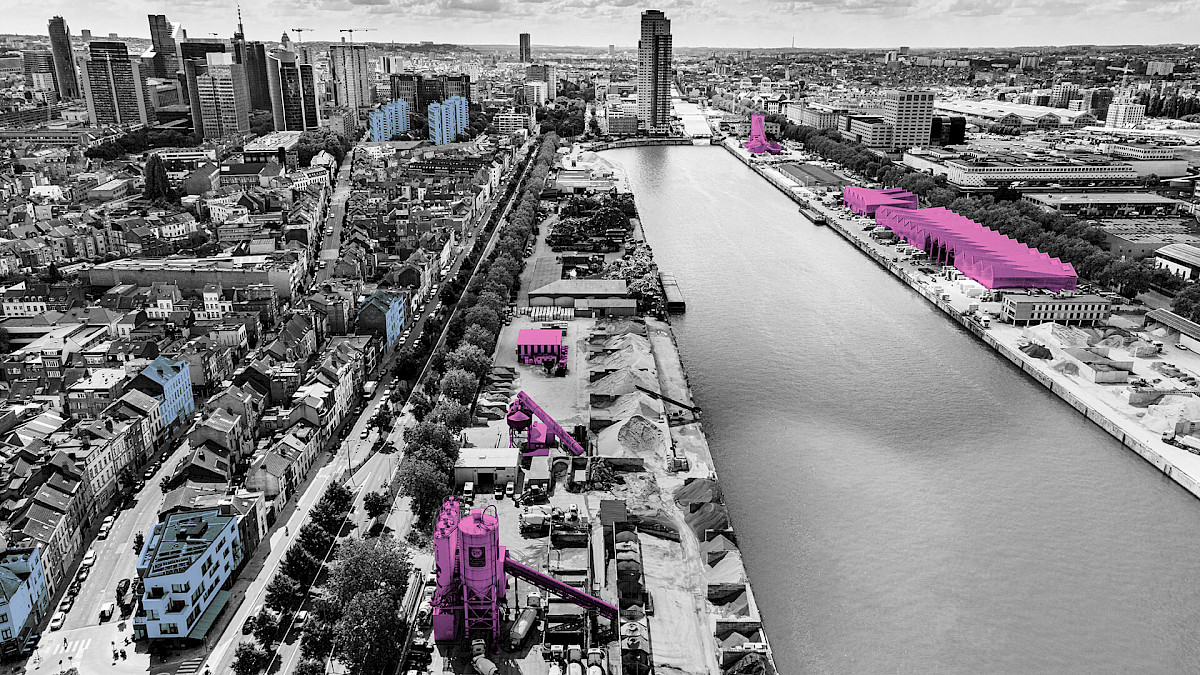
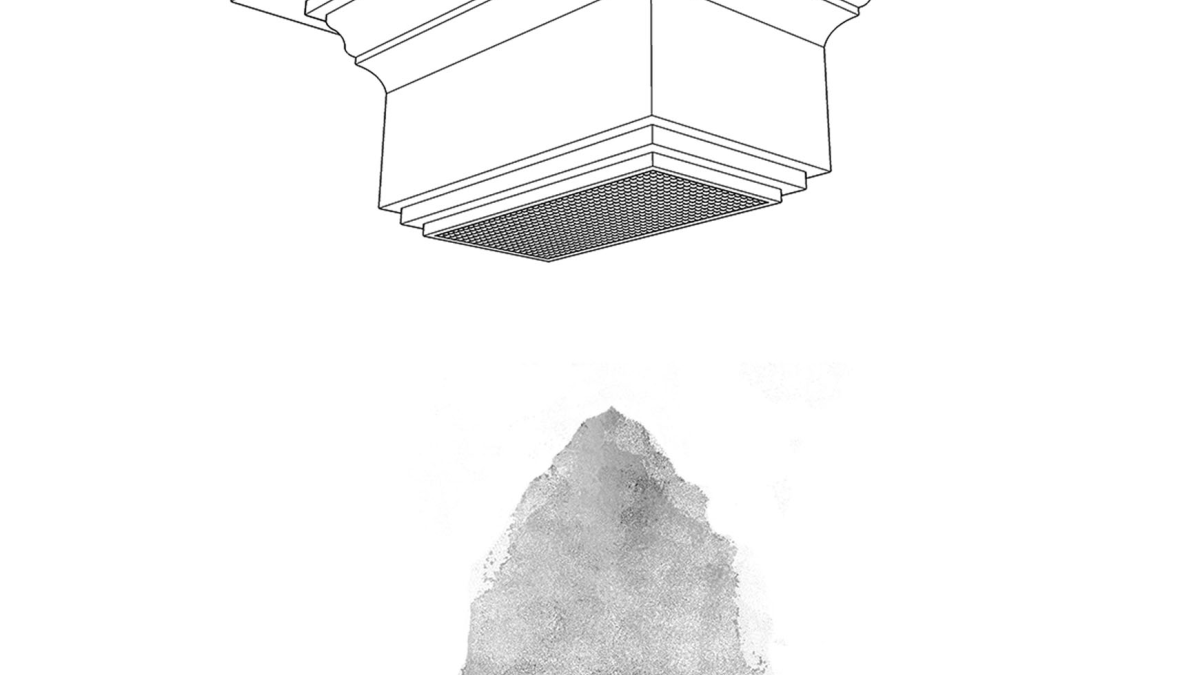
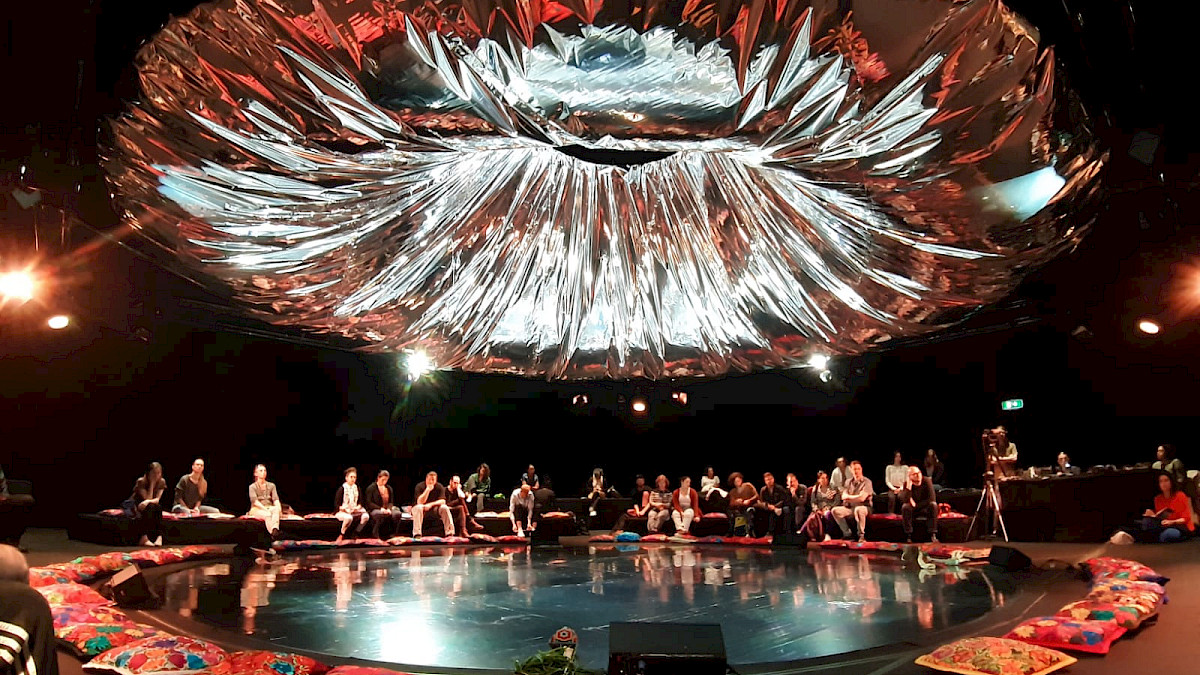
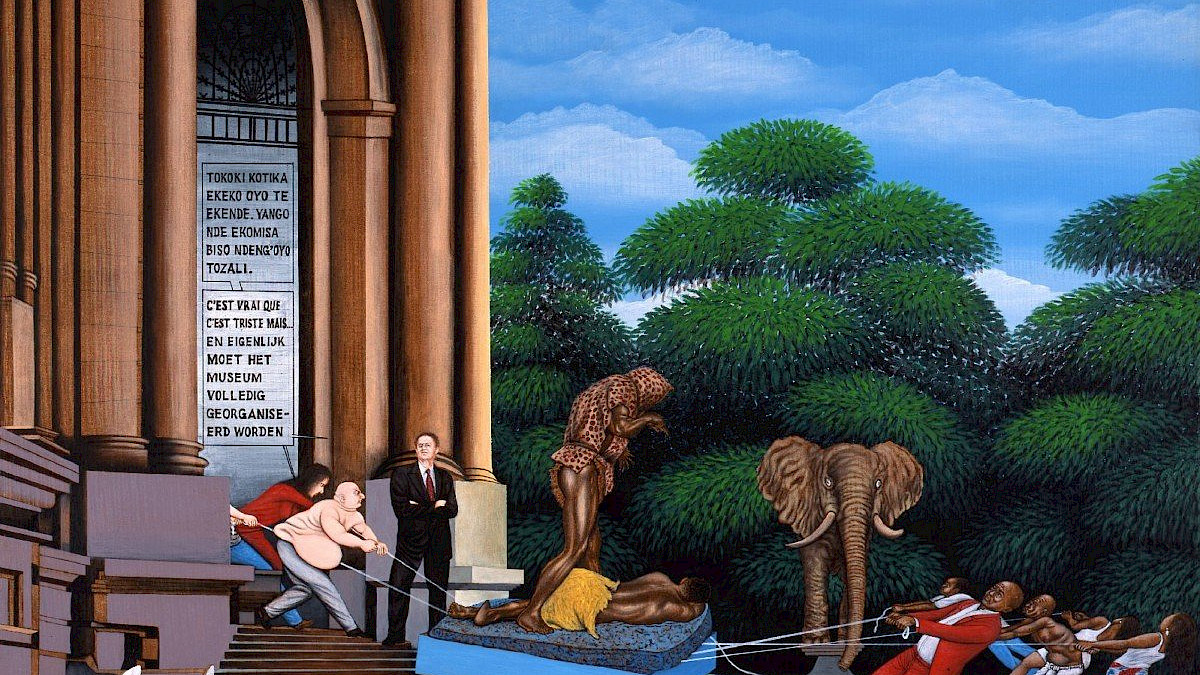
With The Twin Transcripts (2018), Durban-based architect Roanne Moodley re-imagines the French “Fête Nationale,” also known as “Bastille Day,” through a provocative and speculative design of a reconciliatory monumental exchange. Twinning the French town of Montreuil, a banlieue on the fringes of Paris where different African diasporic communities live, to Saint-Denis, the Creole capital of Réunion Island, she makes space to question very present colonial relationalities traversing France and its tropical “overseas prefecture” off the east coast of the African continent. Through processes of ghosting, reflecting, altering, and transplanting in the finely drawn graphic short fiction, Moodley imagines a monumental gift exchange between the Vendôme Column and Réunion’s Victory Column. By importing the Creole Festival of Mixed Freedom to the banlieue of Montreuil in the French capital, she not only creates the right event and setting for this rather uncanny gift exchange, but also disrupts the coinciding imperial military parade memorializing the mythical birth of the Republican Nation on both sides of the ocean, with the too often silenced memory of the struggle against the massive enslavement enforced by the French East India Company.

The (white) elephant in the room here is Napoléon Bonaparte, as one of the main formal differences between the Vendôme and the Victory Column. The Vendôme Column was erected at Napoléon’s direction as a potent symbol of France victory over Prussia in Austerlitz in 1805. The bronze statue of Bonaparte at the top of the original Vendôme Column in 1810, sculpted by Antoine-Denis Chaudet, depicts the French statesman and military leader dressed in Roman attire, bare-headed and crowned with laurels, holding a sword in his right hand and a globe surmounted with a statue of the roman goddess Victory in his left hand. Whereas on top of the erectile pole of the Victory Column in Réunion, the triumphant roman goddess stands alone, to form with its pedestal a cenotaph commemorating and honoring the Reunionese soldiers who died during World War I. Let’s not forget Réunion was shortly re-named “Bonaparte Island,” before it was seized by the British during the Napoleonic Wars. The planned “re-erection” of the Column is for Moodley then an “anti-erection” or a form of subversion, as only the small Caesarian statue of Napoléon (without the 34 meter high tower) would be exposed on the street level of Réunionese Rue de Paris. To paraphrase Ariella Aïsha Azoulay, the “overseas prefecture” of Réunion might in itself be imagined as a monument that must fall, an imaginative act of potential history.

The Mound Vendôme by David Gissen ///

Gissen Funambulist 1
Photomontage from The Mound of Vendôme (2014). / Artwork by David Gissen.

The Mound of Vendôme (2014) is an installation by historian and architect David Gissen that documents the failed petitioned proposition to reconstruct the heap of dirt built by the Paris Commune to break the fall of the Vendôme Column in 1871. It also showcases a series of important archival photographs and engravings documenting the urban square before and after the orchestrated demolition of the Column. The installation returns to the key moment, when on April 12, 1871, the Commune voted on a decree written by Félix Pyat proposing to demolish the imperial Column. The decree stated that it symbolizes barbarism, brutal force, and false glory as it is an affirmation of militarism and a negation of international law. It was seen as a permanent insult and a perpetual attack on the republican principle of fraternity. The demolition was planned for Napoléon’s death anniversary on May 5, but had to be delayed to meet all the required preparations, as we will see in more detail below. The Communards assembled a bed of fascines of hay, sand, and manure along the axis of the Rue de la Paix on both sides for more than 10 meters to cushion the Column’s fall and dampen its vibrations. All the surrounding storefronts and neighboring buildings on the square were closed, and the windows covered. Even with all the precautions, people were afraid that the Column would crash into the surrounding houses in the square or would cause the Opera House sewers to collapse. Instead of echoing the reiterated demand to destroy again the reconstructed Column, Gissen designed collage images and launched a petition to imagine and materialize again the mound of hay, sand, and manure at the foot of the Column. The petition circulated among architects, architectural historians, theorists, and students of architecture throughout the United States and Europe, and was delivered to the director of the Paris Heritage and Architecture Services — with no avail. With this project Gissen intended what he calls a form of “radical reconstruction,” relating histories of social movements, to propose the resurgence of political histories through processes of architectural and urban reconstruction. The failed proposition indeed shows the contemporary reluctance to re-invent revolutionary symbols, and the refusal of the public to be inspired by the Communards’ ingenious ways to carefully reshape the modern urban fabric.

The Anti-Clock Project by Nidhal Chamekh ///

Chamekh Funambulist 2
Destruction of the Vendôme’s Column upon order of Gustave Courbet during the Paris Commune, 1871. / Artwork by Nidhal Chamekh

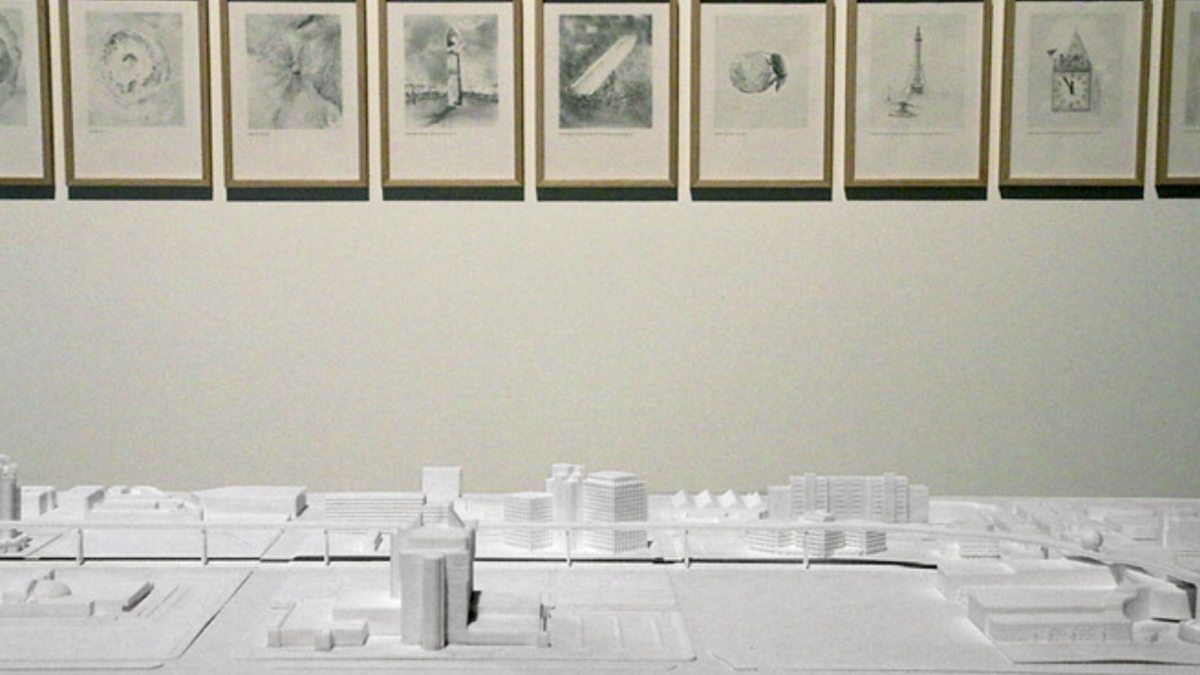
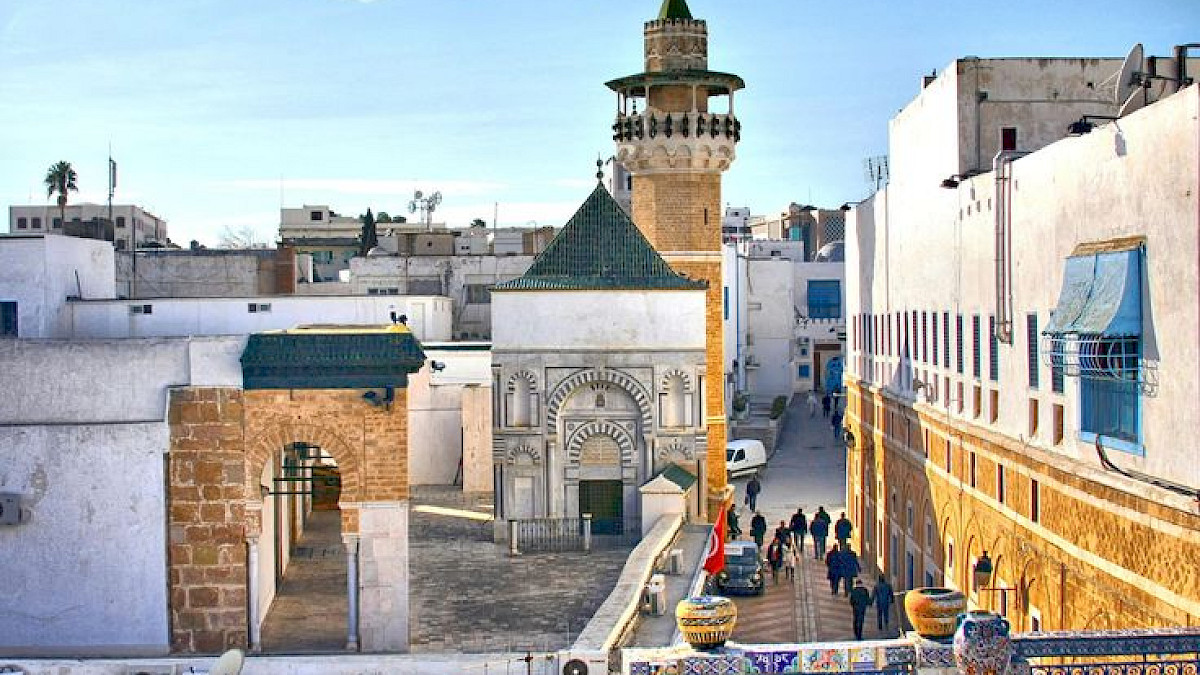
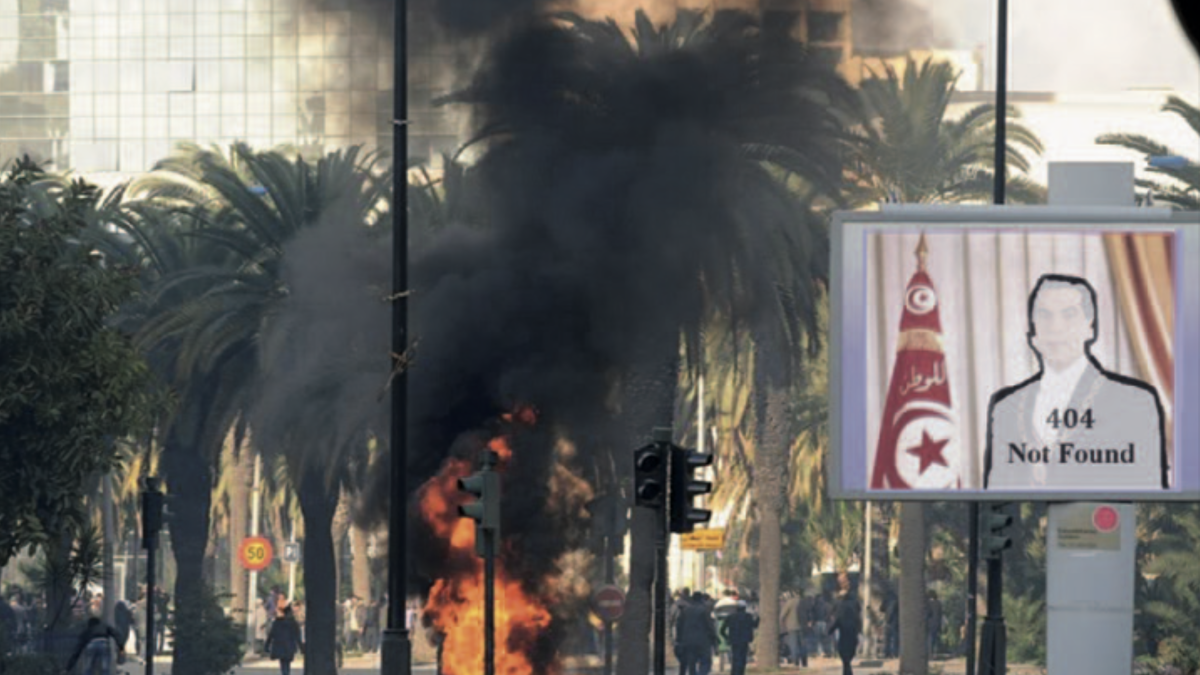
Inspired by the ingenious destruction of the Vendôme Column, visual artist Nidhal Chamekh proposes in the Anti-Clock Project (2015) to demolish the infamous Mongela, also known as the November 7 Clock tower in the center of Tunis during the most recent uprisings in 2011. All the references to November 7 and others references to the numerological cult of the Ben Ali regime in public space were destroyed by the revolting masses, with the exception of the master signifier of the authoritarian landscape.
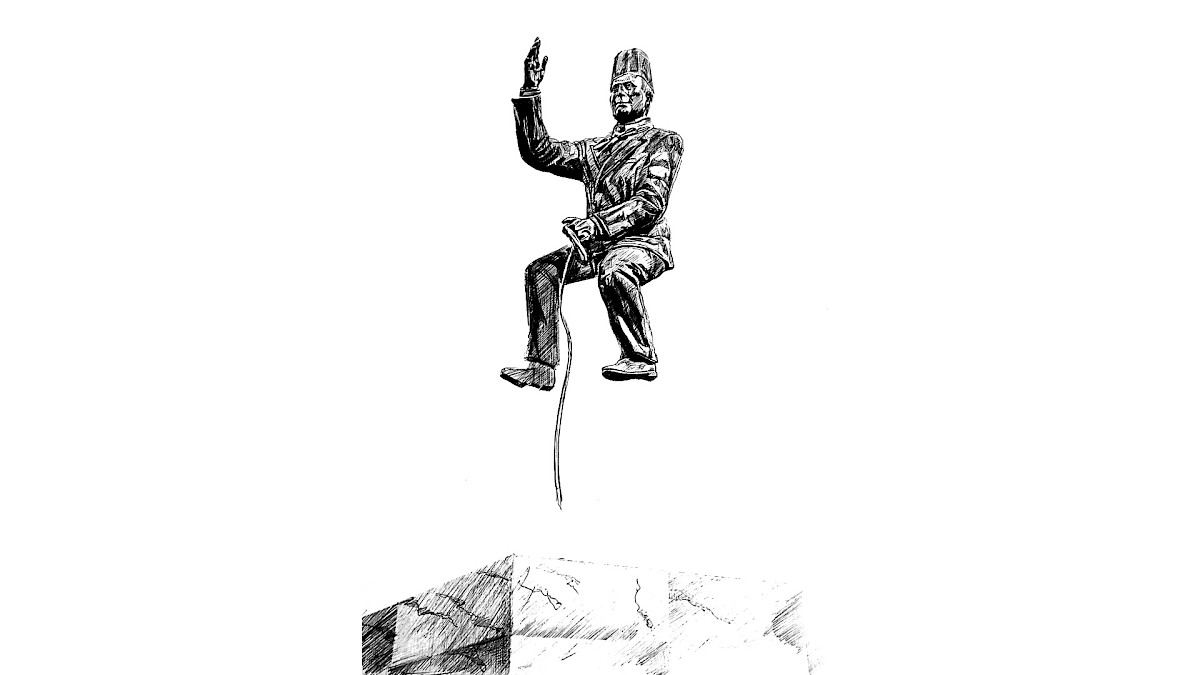
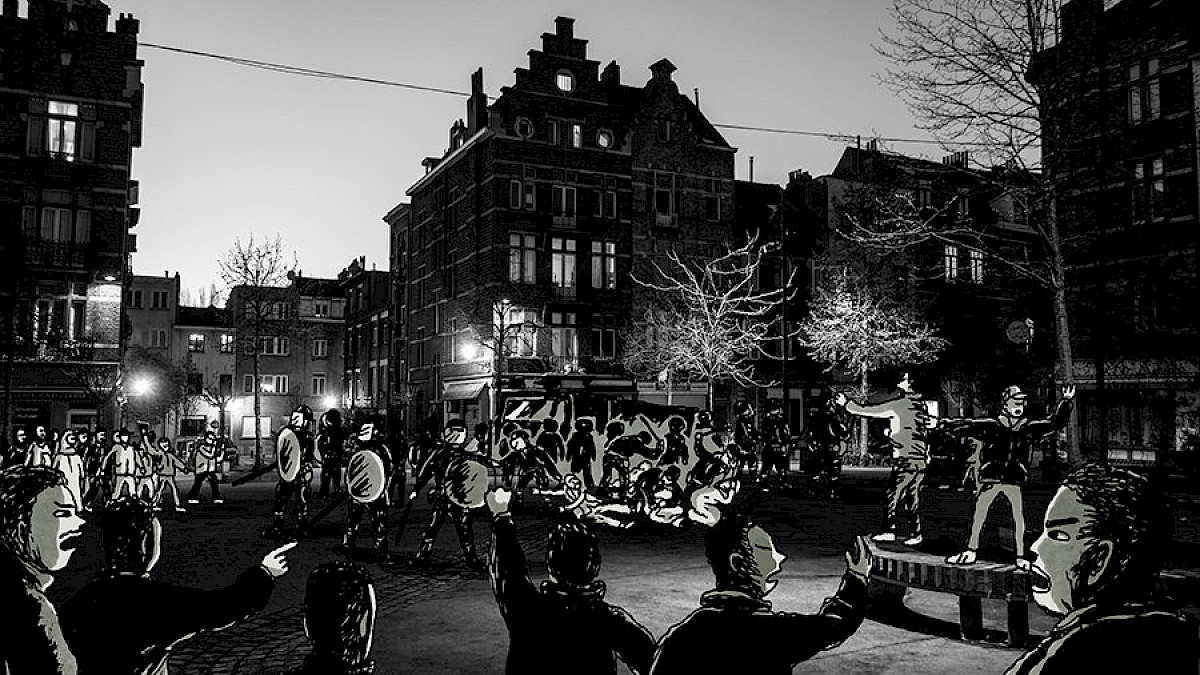
One of the eleven graphite drawings, extending Chamekh’s 3D printed cartographic installation, renders visible the detailed demolition plan of the Commune’s responsible engineer Jules Iribe. To avoid any collateral damage to the fabric of the Vendôme Square, Iribe had foreseen to attach a triple rope to the top of the Column, connecting it to a capstan held on the ground by an anchor. Monitored closely by an astronomical telescope, the efforts of half a dozen men made the capstan turn and the three cables tighten and slowly come together. By operating the capstan, the Column had to give way to its base where it was sawn horizontally a little above the pedestal, and eventually fell on the bed of fascines.

The German poet Heinrich Heine anticipated 30 years earlier the imperial Column and its “Iron Man” could again be overthrown by the “rage of radical equality.” Karl Marx too sensed the coming fall of the Vendôme Column in his 1852 political essay The 18th Brumaire of Louis Bonaparte. The repetition of history as a farce would inevitably mean that the revolutionary working class could eventually annihilate Bonapartism. Or in his own words “if the Imperial mantle finally falls on the shoulders of Louis Bonaparte, the bronze statue of Napoléon will fall from the height of the Vendôme Column.” In the wake of the battle of Sedan, and the defeat of Louis-Napoléon in the Franco-Prussian War in September 1870, the symbols of the Bonapartist regime were purged out of the body politic. The painter Gustave Courbet, president of the Federation of Artists and elected member of the Commune, launched a petition to disassembled this monument “devoid of all artistic value” and move it to the Hôtel des Invalides next to other artefacts dealing with the military history of France, as the implicit sarcasm of an imperial monument venerating the ideals of war and conquest located on Rue de la Paix became untenable.

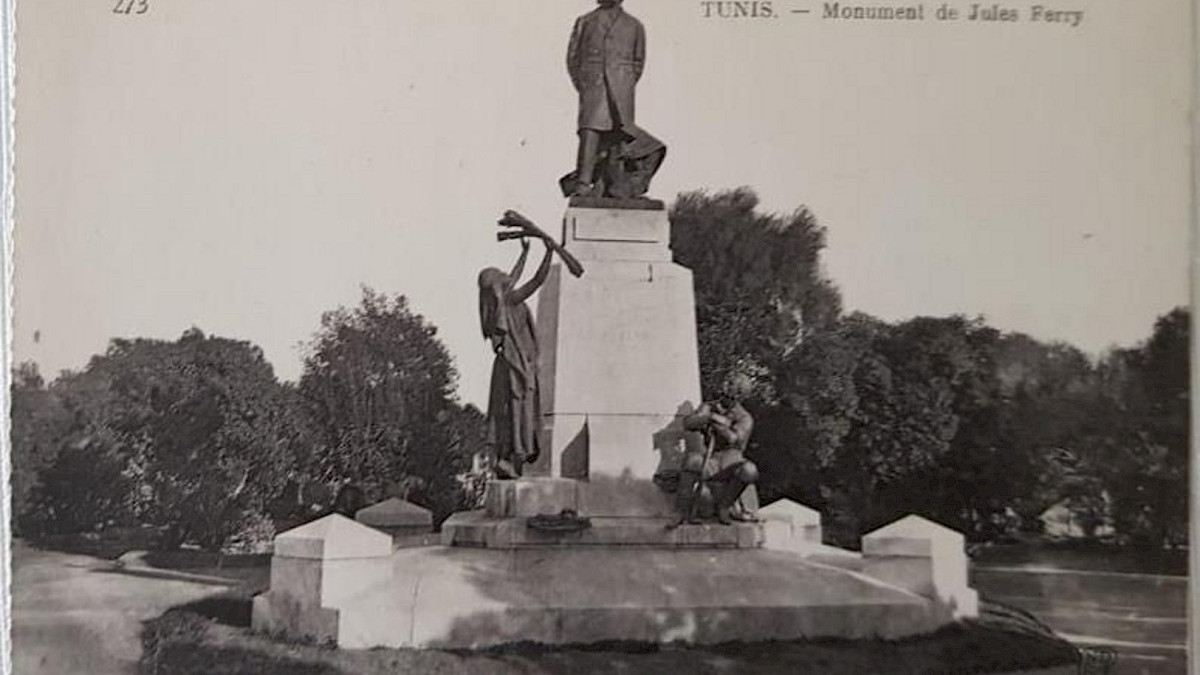
Alas, contrary to the premonitions of Heine, Marx, and the petitioned proposal of Courbet, Chamekh his visionary proposition to demolish the November 7 Clock and subvert it as a new memorial site of the Tunisian revolution did not materialize, yet. The 37-meter high tower, still stands today on January 14 Square, forming the last layer of a colonial palimpsest that started taking shape during the inauguration of Jules Ferry Square in 1911. The Mongela is indeed erected on exactly the same place where once a monument stood in honor of Jules Ferry. During the inaugural ceremony, the sculpture was saluted as the first statue raised in Tunisia since the fall of the Roman Empire, comparing Jules Ferry to a Roman consul. Whereas, in Tunis, Jules Ferry was venerated by the French as the man that embodies the idea of civilization behind the first overseas thrust of the Third Republic and pushed for the establishment of the French Protectorate in Tunisia in 1881. In the Paris of the Communard he was despised as “Ferry-Famine” or “Ferry the Starver,” as in the wake of the defeat of Louis-Napoléon in the Prussian War, he did not manage, as member of the government of National Defense, to ensure enough food supply as the capital was besieged by the Prussian army. He was nevertheless appointed mayor of Paris, but from the first day of the Communal insurrection, he instantly fled the city. The depiction of “Ferry the Starver” as a cowardly imperialist republican, would have certainly resonated really well with the ideas many Tunisians did not dare to speak out loud during the French colonial protectorate. Eventually the statue of Ferry was unbolted, but later replaced by an equestrian statue of “El Moujahid El Akbar” Habib Bourguiba, and eventually followed by the Novemberist Clock Tower as both stand today in the capital.

After imperial or colonial statues are unbolted, breaking the polis in two, it seems incumbent to gather in the monumental debris what is still useful, to carefully deliberate what could still be valuable to relate with and what is not. Today, as much as it was 150 years ago, laboring the intersections, the nodes between different struggles so communalities become intelligible remains inevitable and vital. But imperialist and colonial monuments appear to be stubborn and resilient edifices. Fanon might have proposed to turn our back to Europe, including its working class and its self-proclaimed internationalism, as they are part of the prodigious Universalist spirit anti-colonial movements are fighting against. He nevertheless oversaw the secular illusion or the impossibility to separate the entangled worlds in the lived experience of diasporic or creolized subjectivities. Abdelkabir Khatibi by contrast engages in his seminal book Maghreb Pluriel (1983) in a thorough questioning of the conception of this European game that for Fanon has apparently definitively ended. As that European game inhabits Khatibi’s most intimate being — not as an absolute and devastating exteriority but as a conglomerate of difference — he reclaims an inalienable right to this difference. It is hard work. But the inseparability of entangled worlds in the lived experience of diasporic or creolized subjectivities, can then be mobilized in a productive and critical way. This is made clear in the provocative reversal central in Moodley’s Twin Transcripts, to re-animate new forms of solidarity and fundamentally rethink obsolete historical forms of internationalism from below, re-articulating them in translocal solidarities to by-pass any form of nationalism.

From this hybrid understanding of our subjectivities it is clear that we inhabit the manifold Manichean binaries proper to racial capitalism, and that we just cannot turn our back to the internationalist spirit of the Paris Commune. As shown in the drawing of Chamekh’s Anti-Clock Project, these binary contradictions, whether in Paris in 1871 or Tunis in 2011 can only be undone and disentangled through relational and collective forms of ingenious labor, unbolting a monument after all implies meticulously engineered preparations. The measurements have moreover necessarily to take into account the materiality of that monument. Panafrorevolutionary collective Cases Rebelles reminds us that the intensified demands to dismantle imperial monuments venerating these presupposed national heroes, are not merely symbolic demands, but demands for justice, tightly linked to infrastructural demands of reparations (see The Funambulist 30 Reparations, 2020).

It might be too messy or speculative to include the monumental contestation of the Paris Commune in the denomination of decolonial rage. The abstract expression and universal condemnation of colonialism and imperialism is after all something fundamentally different than forging real relations of solidarity and care with anti-imperial and anti-colonial struggles on the ground. But let this messy speculation be part of a larger necessary exercise in revolutionary love. Both the survivors of the defeated Mokrani revolt in Algeria and the defeated Commune were in the end and after all both sitting side by side, both dispossessed
and incarcerated in the same French prison in New Caledonia on Kanak land, thinking of their loved ones alike and their vanished dream of liberty and dignity. As we learned from Gissen’s petitioned proposal of radical reconstruction in The Mound of Vendôme, we can anticipate the demolition of monuments, and carefully prepare the bed on which it would fall to preserve the urban fabric to be damaged. Overthinking collectively the possible erasure of monuments is then a condition to see and feel the horizon. Excavating overlapping and interconnected monumental histories, might inspire a renewed breath of revolutionary love, so necessary in this time of generalized suffocation and internal fragmentation. This archeological exercise might inspire possible new translocal solidarities, more caring forms of planetary alliances, that could prefigure new ways of inhabiting another world in freedom and dignity, a world where many different worlds fit. ■
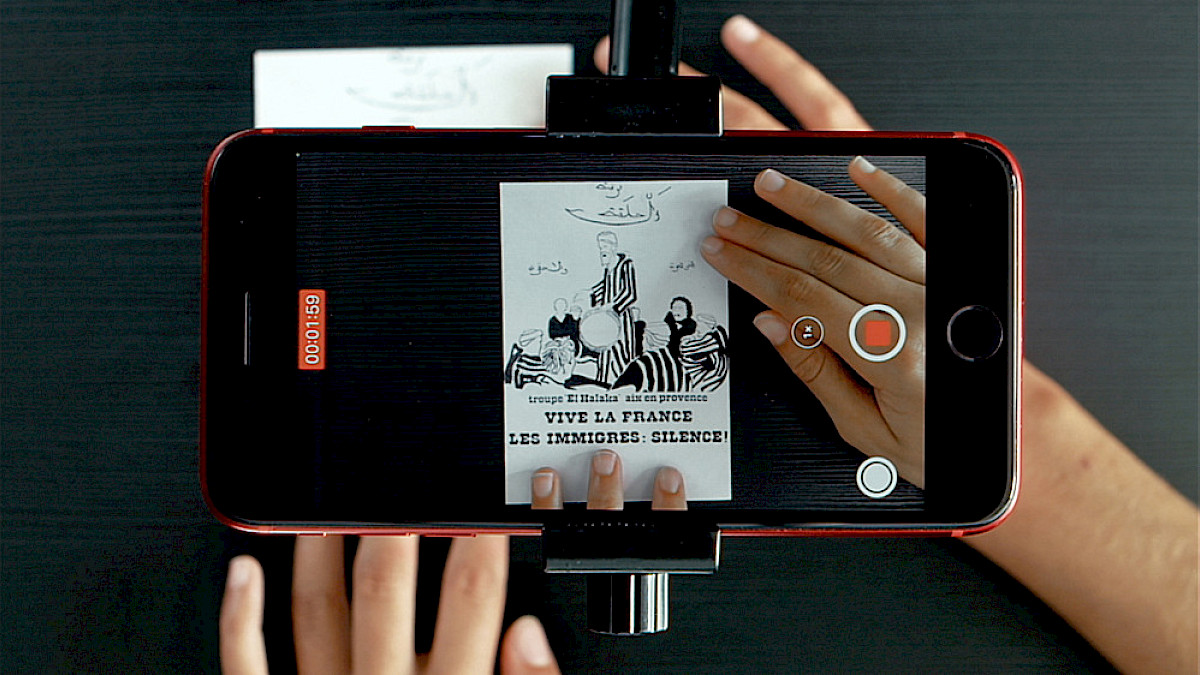
Ahl El Hijra - Qu'est ce que se passe-t-il a Schaerbeek?

What's Happening in Schaerbeek?

14-10-2025
Articles
Bruxelles
Maghreb
Mustapha Bentaleb
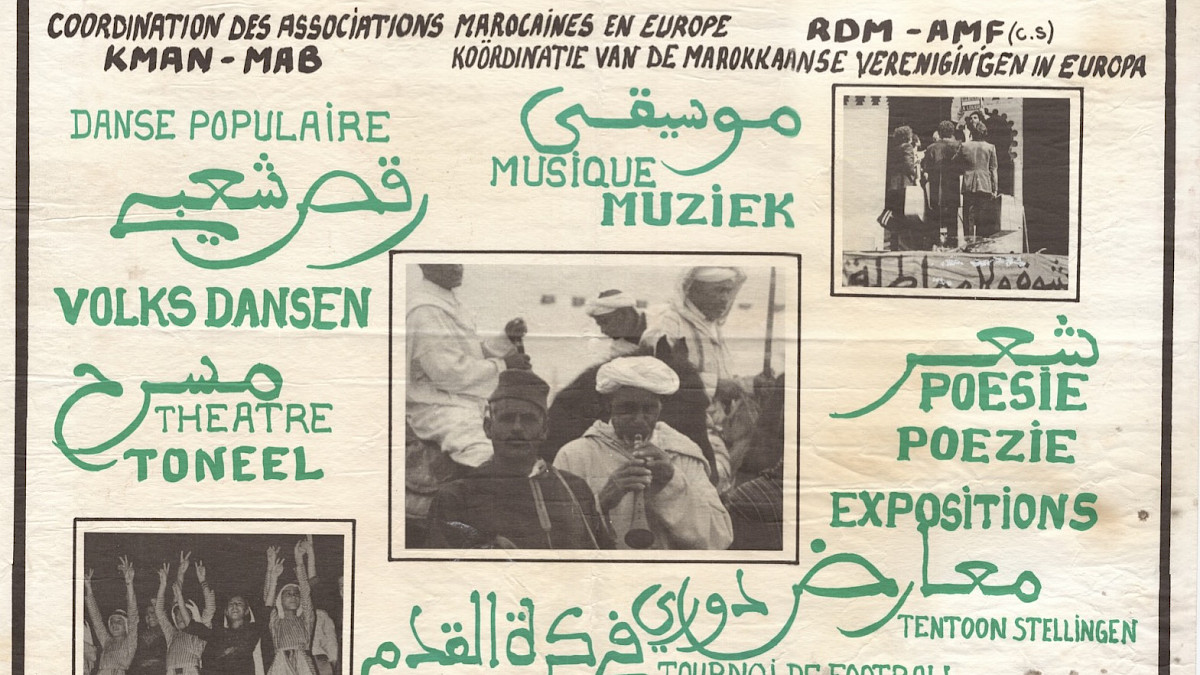
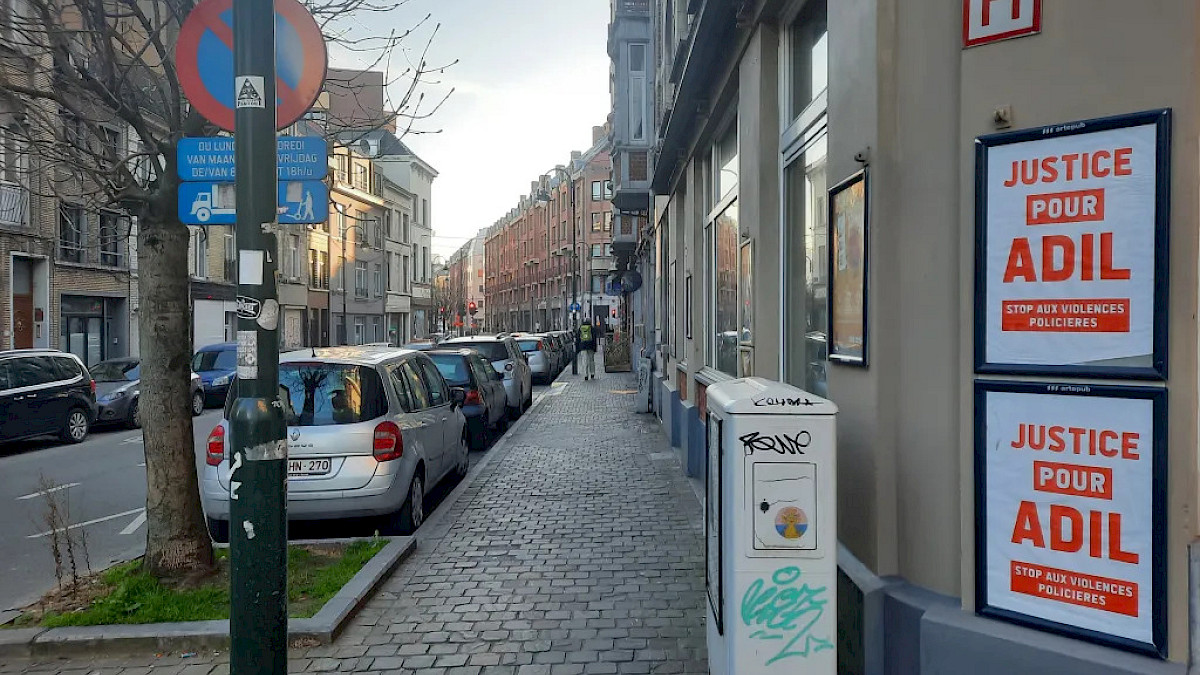
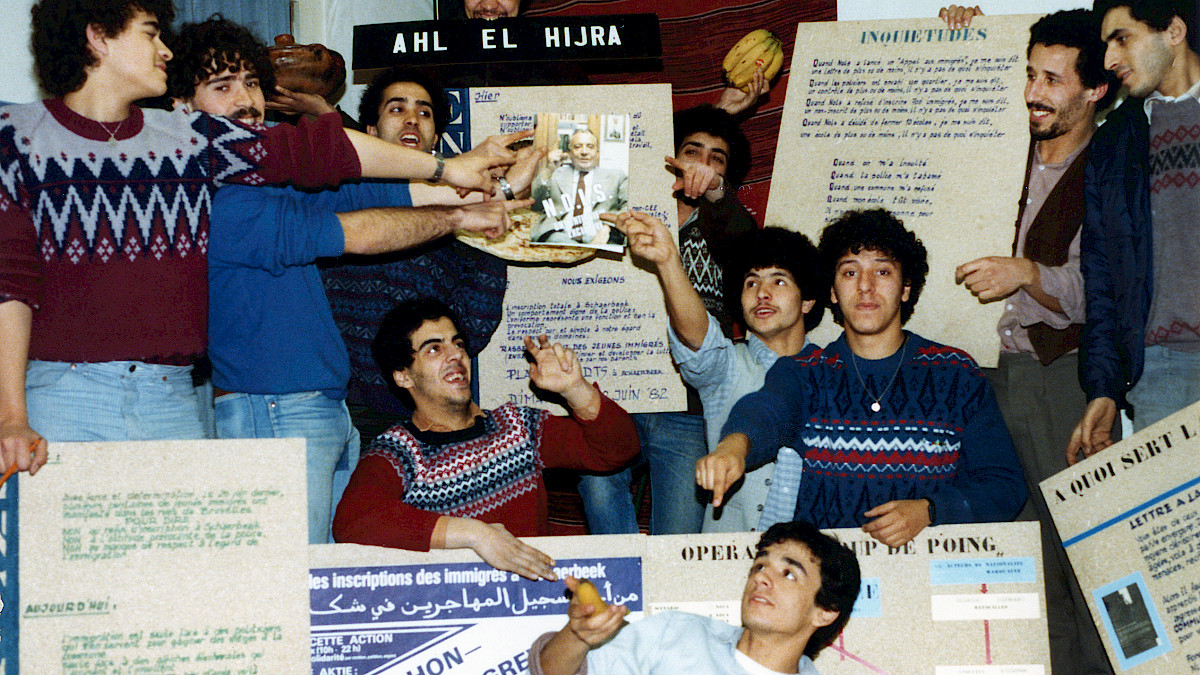
As editors, we arrived at this contribution by Mustapha Bentaleb and Joachim Ben Yakoub somewhat like latecomers to a gathering, where a conversation is already unfolding, photographs are being passed around, and old songs still linger in the air. What we encountered was not a linear narrative, but a constellation of memories, documents, names, and voices—partially preserved, partially reconstructed. The setting is a contemporary collective workspace in Brussels, known as The Kitchen. There, the authors imagine a gathering with members of the former cultural-political group Ahl el Hijra, sharing yellowing photo- graphs, leafing through copies of Tribune Immigrée, and reflecting on acts of resistance from early 1980s Belgium. This layered return—across time, media, and memory— invites us to consider not only what remains of these histo- ries, but how we reassemble their fragments in the present. At the heart of the story is Schaerbeek, a working-class district in Brussels where many Maghrebi workers settled following the 1964 labor agreement between Belgium and Morocco. In 1982, under Mayor Roger Nols, immigrant residents were systematically excluded from the municipal registry—cut off from basic social rights such as legal recognition, welfare, and access to schooling. In response, Ahl el Hijra launched a series of actions: a hunger strike, public gatherings, and a collectively built exhibition titled What’s Happening in Schaerbeek?. This contribution returns to that moment, by allowing fragments to speak. Archival photographs, interviews with a former member of Ahl el Hijra, pages from Tribune Immigrée (Issue 4, Feb.–Apr. 1982), and the protest song His Imprisoned Shadow converge to form a scattered composition ... What follows is not a definitive account, but a listening position, attuned to what surfaces when the past is reopened in the present. Taous Dahmani & Tom Viaene
Atef Maatallah

Monumental Re-Bourguibization

23-01-2025
Papers
Atef Maatallah
In January 2016, the first President of post-revolutionary Tunisia, Beji Caid Essebsi addressed the people, from exact the same setting as former president Habib Bourguiba’s in January 1984’s speech to contain popular revolts. In the proposed book chapter, I venture into the power dynamics proper to the constitution and reconstitution of state aesthetics in the process of monumental re-bourguibization. As the appropriation of spectacular power in different cities over Tunisia such as Sousse, Monastir or Tunis, was met with new waves of artistic resistance, my contribution to the book takes notice of the often-overseen processes through which aesthetic agency was temporarily halted by the re-emergence of new forms of authoritarian symbolic politics during the post-revolutionary phase. Based on a long-term participant observation in the field of visual arts in Tunisia between 2011 and 2017 and combining insights from aesthetic theory and various postcolonial critiques, I show how monumental aesthetics are not structured overnight. Looking into the formation of spectacular power in the longue durée, I argue that the thousand eyes that constitute contested monumental aesthetics in Tunisia are historical constructions, characterized by a palimpsestic structure that reveal its postcolonial disposition. This historically detour helps to untie the present apparent contradictions proper to the ambiguous processes of monumental de-bourguibization and re-bourguibization. Through the self-conscious, ostentatious, and aesthetic gesture of over-writing one symbolic order by another, the site of former colonial and postcolonial power is marked with at times opposing narratives and counter narratives of national becoming, forming a renewed, multilayered but contested site of postcolonial spectacular power. Published in the volume Art Against Authoritarianism in Southwest Asia and North Africa, edited by Tijen Tunali and Josepha Ivanka Wessels (I.B. Tauris, 2025
It's like a Finger Pointing a Way to the Moon

It's like a Finger Pointing a Way to the Moon

18-04-2024
Projects
Bruxelles
Tsumkwe
Moya Michael
!Amace
Be
Victoire Karera Kampire
Simon Thierrée
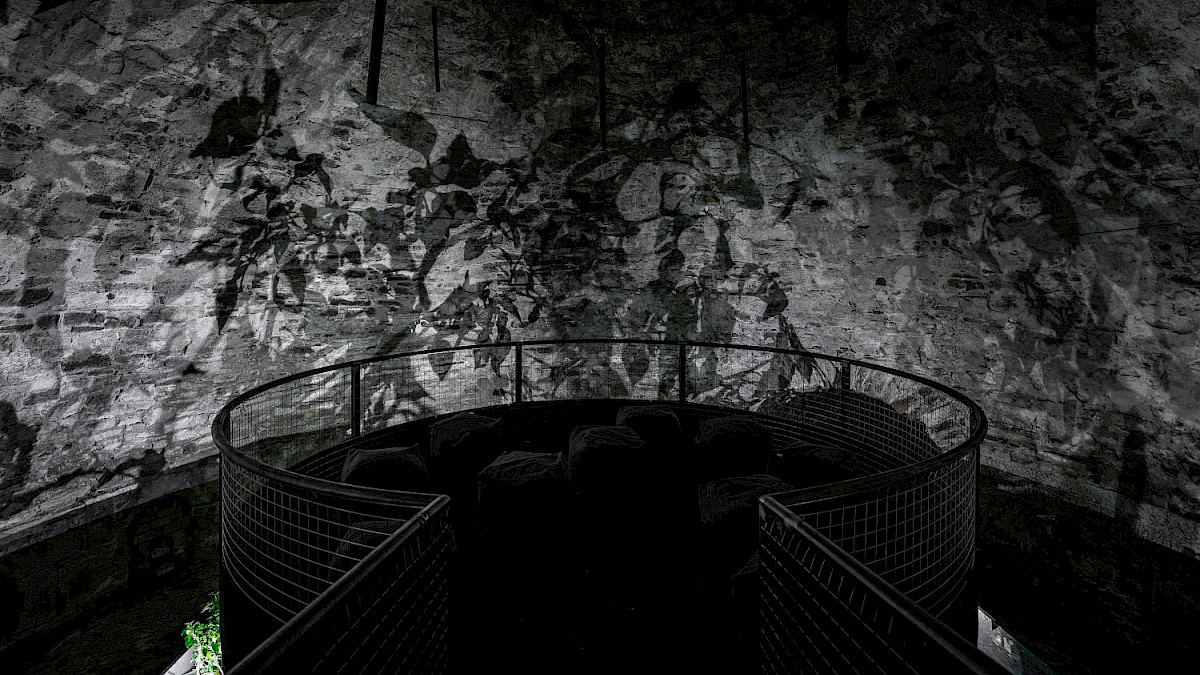
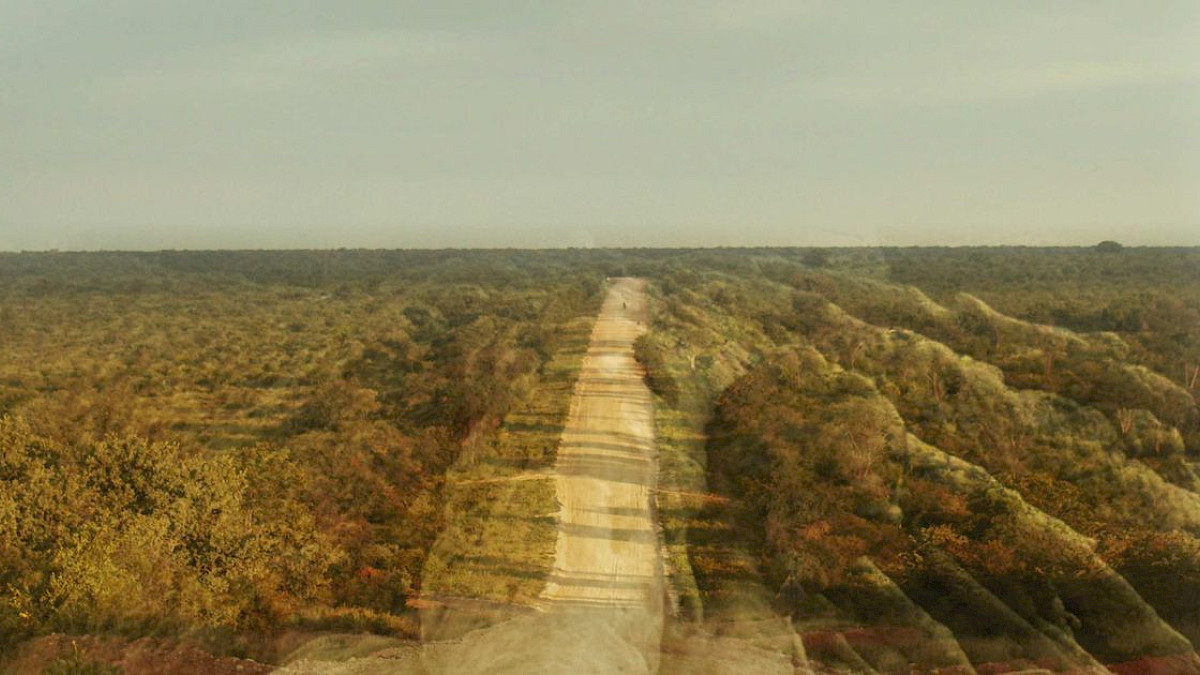
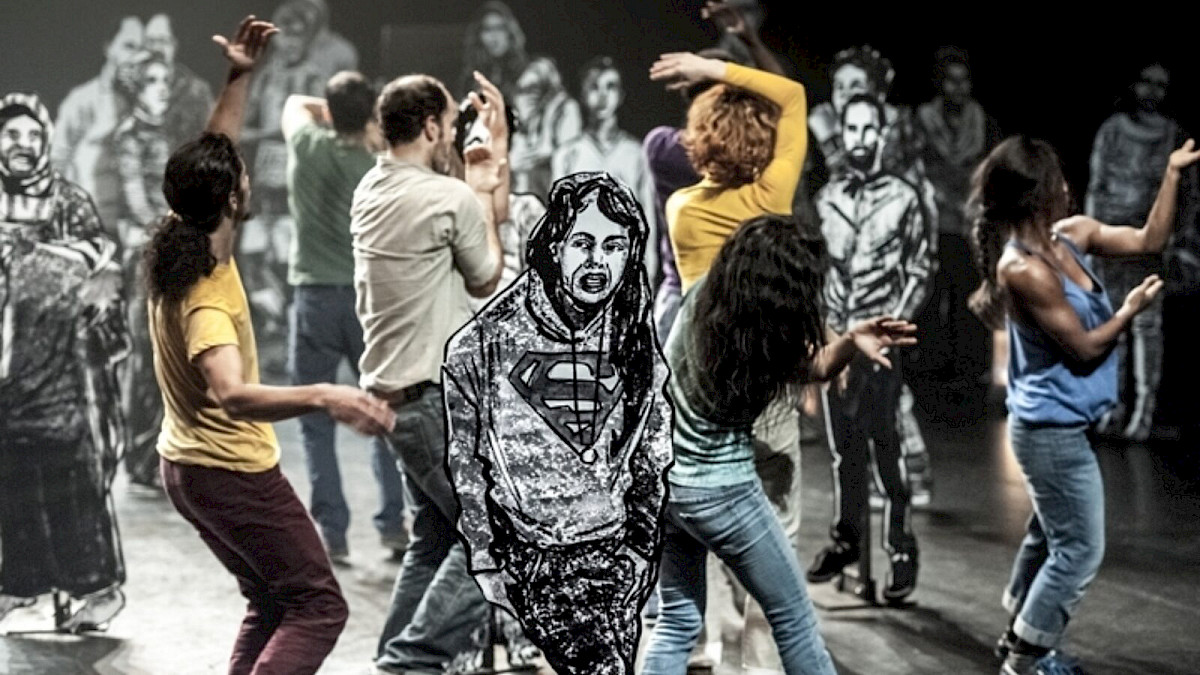
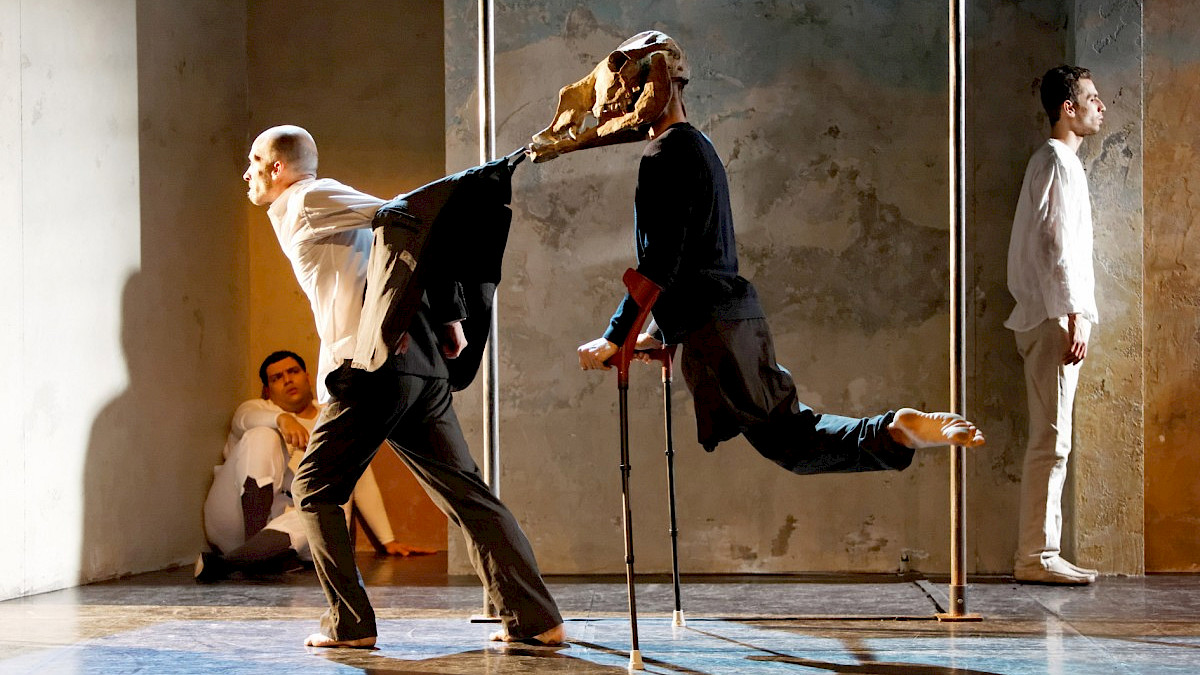
In It is like a Finger Pointing a Way to the Moon Moya Michael is searching for the movement of different unyielding languages. After the celebrated Coloured Swan trilogy and Outwalkers, choreographer Moya Michael proposes to dance nearby the guardians of words, movements, and rhythms she encountered in South-Africa and Namibia.  Drawing inspiration from Bruce Lee’s famous line in Enter the Dragon—“Don’t concentrate on the finger or you will miss all that heavenly glory!”—Moya Michael sets out to explore the worlds of words, movements, and rhythms she encountered in South Africa and Namibia. After spending time with !Amace, Be, and their Ju/'Hoansi family, she joins forces with artists Victoire Karera Kampire, Simon Thierrée, and Joachim Ben Yakoub. Through the precise use of image, movement, and sound, a liminal space of ongoing transformation is created, inviting reflection on oral tradition and survival. Together, they delve into the movement within different unyielding languages. Guided by Bruce Lee’s allusion to an old Zen Buddhist wisdom in his seminal film Enter the Dragon, “Don’t concentrate on the finger or you will miss all that heavenly glory!”, she proposes to move with what we cannot fathom. To disappear in order to preserve the words that precede us, that never left us. To transform in order to keep what came before us.   CREATION Moya Michael IN COLLABORATION WITH Victoire Karera Kampire, Simon Thierrée, Joachim Ben Yakoub SCENOGRAPHY Špela Tušar COSTUME DESIGN Andrea Kränzlin VIDEO Victoire Karera Kampire SOUND DESIGN Simon Thierée LIGHT DESIGN & DIRECTION Ellie Bryce SOUND Patrick Van Neck DRAMATURGY Joachim Ben Yakoub STAGE MANAGER Caroline Wagner PRODUCTION MANAGER Lise Bruynseels  DISTRIBUTION Cecilia Kuska PRODUCTION KVS COPRODUCTION WIELS, Perpodium, Bergen Kunsthall       
The Question of Funding

[Kitchen Broadcast] On ways of hosting, (under)commoning and insituting otherwise

01-06-2023
Conversations
Palestine
Bruxelles
Belgrade
Ramallah
Bojana Cvejić
Yazan Khalili
Reem Shilleh
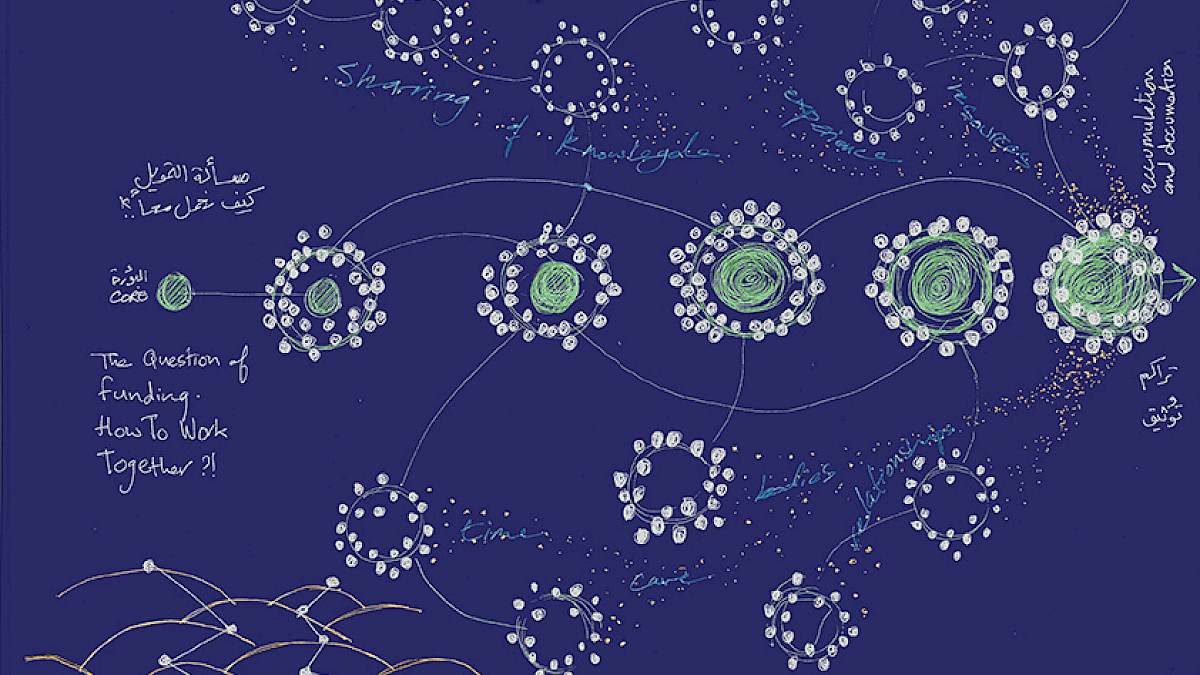
For the fourth episode of Kitchen Broadcast, we had lunch with Bojana Cvejic and Yazan Khalil and took the time to talk and exchange ideas about the infrastructural conditions and ways of hosting, (under)commoning and insituting otherwise, starting from both their practices in setting up different spaces and places. Bojana Cvejić is on of the co-founders, together with Jan Ritsema and still an active member of PAF (Performing Arts Platform)a residency in a small villange St Erme in France close to the Belgian border. She is also, among many other things, active in TkH (Walking Theory platform) an independent, institutionally non-aligned, extra-academic platform for performing theoretical-artistic activism. Yazan Khalili engaged in the transformation of Khalil Sakakini Cultural Center in between 2015 and 2019 in Ramallah, Palestine, and continued his reflections on processes of instituting through different projects, among many other things, the QAF or the Question of Funding and Aka, a space hosting a decentralized network of self-organizing and grassroots collectives in Kassel. Kitchen Broadcast is an ongoing online conversation that proposes to listen to different voices, different rhythms and different sounds, reflecting on present situations that intersect in Brussels, composed by Joachim Ben Yakoub and Reem Shilleh. It is produced with the kind support of Kaaitheater, a stage for dance, theater, performance, music and debate in Brussels.
Jara Mosque by El Seed - Ouahid Berrehoumav

Turning a City Inside-out

07-07-2022
Papers
Tunisia
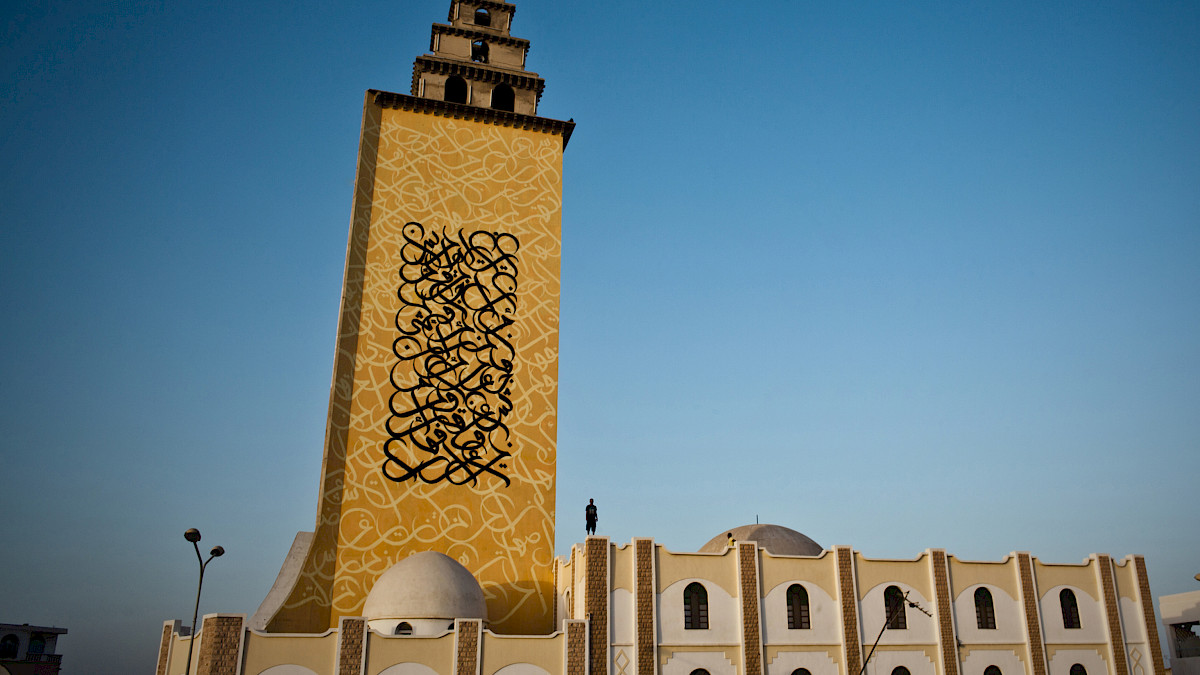
The spatial dynamics were difficult to overlook during the 2011 movements of revolt in Tunisia, pushing the damned in the center of public attention in the concerted effort of turning prevailing authoritarian politics inside–out. Venturing in the spatial contestation central in these revolts, the mesmerizing occupation and re-appropriation of symbolic places, such as the Kasbah Square or Bourguiba Avenue took center stage. These movements of occupation and re-appropriation of spatial power produced momentous heuristic enclaves of another order, projecting dreams of a renewed inclusive free and dignified body politic. Based on a long-term research in the field of visual arts in Tunisia between 2011 and 2017 and the combination of various postcolonial critiques, this article demonstrates the way in which violent processes of destruction preceding these processes of re-appropriation and occupation are too often overlooked. Police stations, the presidential personality cult and the private estate of the authoritarian regime are identified and treated as spatial nodes that maintain the compartmentalization and fragmentation of urban space in place. Moreover, by including in the analysis the often-omitted Islamist occupation and re- appropriation of mosques and public space contesting the ongoing constitutional political dynamics, this article elucidates why the revolutionary process failed in the production of a long aspired liberated and dignifying space, as the revolutionary re-appropriation of these symbolic nodes of power was not included in any political agenda.

La naissance d’une pensée et d’une pratique-autre en Tunisie post-révolutionnaire

01-07-2021
Papers
Malek Gnaoui
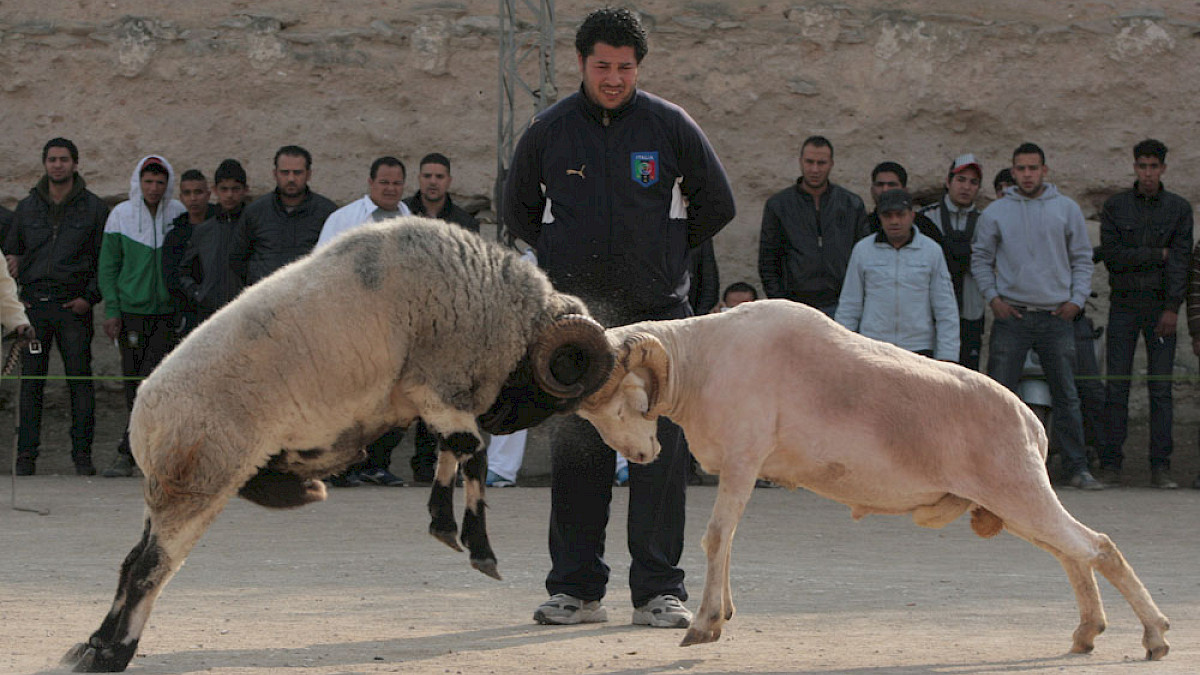
Dans un premier temps, je voudrais approfondir la figure du mouton noir dans l'œuvre de Malek Ganou, et ceci en relation avec un contexte politique précis : les diverses controverses liées à la relation tendue entre une liberté nouvellement acquise et les collectivités militantes islamistes fraîchement constituées – ce qui interroge les limites du sacré dans l'espace public. Dans un second temps, j’examinerai la performativité de l'installation vidéo mobile Dead Meat Moving et sa relation au geste du sacrifice, en réimaginant le mouton noir à travers la figure du corps précarisé et étouffé des damnés de l'histoire tunisienne, trop souvent réitérée dans la figuration du harrag, martyr ou djihadiste, trois subjectivités sacrifiées aux frontières globales de la postcolonie. Ensuite, j’analyserai le Black Show, qui illustre parfaitement ce qu'Abdelkebir Khatibi1 appelle une double critique, nécessaire pour affronter des constellations politiques complexes et violemment conflictuelles. Enfin, je rapproche les deux éléments du diptyque, non pas pour condamner le jeu populaire des combats de béliers, ni le rituel religieux candide et profondément significatif mais, bien au contraire, afin de démontrer comment, dans leur composition performative, Dead Meat Moving et le Black Show ont réussi à transformer ce qui est désapprouvé, marginalisé et désolé, en ce que Homi Bhabha appellerait un tiers-lieu critique et sensible, permettant l’apparition non seulement d’une pensée- autre, mais aussi d’une pratique-autre post-révolutionnaire trop souvent réduite au silence et donc inouïe. Un Chapitre publier dans le livre Attaques # 3. (2021, p.323-343)
Mohamed Bourouissa- Brutal Family Roots (c) Selma Gurbuz

Meandering in a Land of Selfless Love

30-06-2021
Articles
Hasselt
Algiers
Martinique
French Guiana
Mali
Silvia Franceschini
A walk through the exhibition “Le Déracinement. On Diasporic Imaginations” In spring 2021, Z33 – House for Contemporary Art, Design & Architecture in Hasselt, Belgium hosted the exhibition Le Déracinement: On Diasporic Imaginations. Curated by Silvia Franceschini and including work by artists Mohamed Bourouissa, Kapwani Kiwanga, Raphaël Grisey & Bouba Touré, Mathieu Kleyebe Abonnenc, Fatma Bucak and the Otolith group, the whole visual dispositif of the exhibition was centered around French sociologist Pierre Bourdieu’s photographic work, produced in Algeria between 1958 and 1961.  Upon visiting, I wondered how an exhibition revolving around the photographic work of a sociologist such as Bourdieu might relate to intrinsically colonial dynamics of uprooting and displacement. But also how a curator operating in an art institution such as Z33 might relate to such a sensitive and thorny topic as diasporic imagination, in the intrinsic contradiction of showing this work within such a—at times violent—context of an institutionalized museum. Nonetheless, I decided to put that set of questions aside for a moment, and surrendered myself to the challenging winding path set out by Silvia Franceschini. My understanding of the process of uprooting and diasporic displacement eventually turned inside out, moved from the liberated land of Algeria and Mali, via the still colonized overseas departments of Martinique and French Guiana, over the hearth of British Empire through the Black Atlantic to end in contemporary war-ridden Syria.
Sacré Printemps! CHATHA

Kitchen Broadcast: Exiger des transformations historiques quelque part entre le Maghreb, Paris et Bruxelles

17-12-2020
Conversations
Tunisia
Bruxelles
Paris
Nidhal Chamekh
Hela Yousfi
Mohamed Toukabri
Reem Shilleh
Kitchen Broadcast est une émission radio en ligne programmée par Joachim Ben Yakoub et Reem Shilleh. Avec la participation de Hela Yousfi, Mohamed Toukabri et Nidhal Chamekh, ce dîner Kitchen Broadcast propose une réflexion critique sur les remises en question postcoloniales et la promotion de transformations historiques – quelque part entre le Maghreb, Paris et Bruxelles. Il y a précisément dix ans, en décembre 2010, la Tunisie a embrasé le monde. De la Kasbah de Tunis à la place Tahir du Caire, de la plaza del Sol à Madrid à la place Syntagma à Athènes au centre du monde capitaliste de Wall Street, la terre entière était « occupée » par n sentiment d’indignation. Alors que les demandes de liberté ont été aisément satisfaites par des réformes démocratiques cosmétiques, les demandes de pain et de dignité restent lettre morte. Toutefois, l’autoritarisme mondial, alimenté par des violences policières, du racisme et de l’islamophobie paraît progresser, également en Europe. Contrairement à Bruxelles et à Paris, la décolonisation n’est pas (encore) une métaphore au Maghreb. Après près d’un siècle et demi de domination coloniale, six décennies de gouvernance postcoloniale et à présent dix ans de révoltes au Maghreb, les demandes décoloniales peuvent y sembler caduques de prime abord, au mieux anachroniques. Néanmoins leur timide résurgence actuelle dans les discours d’une minorité diasporique témoigne d’une possible reviviscence. Il est grand temps de mener une discussion en profondeur.

Revolting Senses. The contrapuntal Aesthetics of Revolt in Tunisia

21-11-2018
Books
Tunisia
Combining key insights from aesthetic theory and various postcolonial critiques, this research looks into the aesthetics of revolt. Taking the recent and exceptional sequences of revolts in Tunisia as a case study and thus starting from an extensive and unique fieldwork, and by unraveling contrapuntally the complex entanglement of processes of politicization of aesthetics and the aestheticization of politics, revolting senses show how state aesthetics are always historically formed and how the sensible, or that what can be seen, imagined or embodied, is consequently shared, divided and distributed, but also how accumulated aesthetic agency can question and possibly alter this shared distribution in times of revolt. This study apprehends revolt in a phenomenological way as a lived, embodied and visual experience and thus as a process of diversion or reappropriation of spectacular power. It contends that revolt has the potential to alter a given police order. Nevertheless, the often too precipitated contentions that the moving body politic would have radically altered the order of the sensible, during the latest sequences of revolt in Tunisia, is altogether tempered. This dissertation points at the intricacies that accompany the processes of revolt against a firmly seated police order, especially the difficulty of creating different conditions of intelligibility and possibility that entail a fundamental transformation of what appears to sense experiences. These particular intricacies could somehow have been foreseen as aesthetics was explicitly grasped as a historically formed contrapuntal ensemble or as an all-encompassing realm that is made of different intermeshed, overlapping, and mutually embedded histories traversed by a colonial divide.

Performing Self-sacrifice, Despite Everything or Despite Oneself?

04-10-2018
Papers
Fanni Roghman Anni
Danceurs Citoyens
The authoritarian regime in Tunisia can be defined as an intensive bio-political regime where disciplinary techniques of surveillance and governmentality are entangled with sovereign logics of exceptionality and decisionism. Authority and power is woven through every aspect of everyday life and to exceptional instances of the power over life and death. Within a bio-political imperative, the body must constantly be managed, governed and controlled. The body is therefore at the same time the strongest medium to enact protest. In this light, we can read the self-sacrifice of the different martyrs during the liberation phase of revolution as a potent symbol of disruption of the expected cooperation of the body within bio-political power that allowed for the appearance of the people in all its complexity and diversity, including the life of the most disenfranchised. Comparing the performances of Fanni Roghman Anni and Danseurs–Citoyens, two different collectives that emerged during the revolution, the performance of self-sacrifice will further be analyzed as a condition for the coming into being of a necro-political space of appearance. Not only the bodies in the street but additional embodied artistic performances during the constitutive phase of the revolution produce extra-discursive effects outside the bio-political logic, that allowed to further engage in fundamental ethical question in the future constitution of new post-revolutionary body politic. Published in the volume edited by Gržinić Marina and Aneta Stojnić, Shifting corporealities in contemporary performance: danger, im/mobility and politics. (Springer, 2018: pp 251–274)
Selma @ Sofian Oussi - Here(s)

The Dream Collaboration

07-07-2018
Articles
Tunisia
Bruxelles
Selma Ouissi
Sofiane Ouissi
The online dance performance Here(s) of the inseparable artist duo Selma and Sofiane Ouissi took place in October 2011 during the opening of the Meeting Points 6 festival, an initiative of the Young Arab Theatre Fund. Sister and brother Sofiane en Selma gradually formed - from one performance to the next - a single body through their shared practice as dancer and choreographer, until Selma moved to Paris and Sofiane was left alone in Tunis. Thanks to real-time video communication applications, they managed to bridge the distance between both metropolises and thus found a way to reconstitute their shared practice and reflection. During Here(s) they share this initially rather practical communicative bridging, which gradu- ally grew into a full-fledged choreography. In what follows we will delve deeper into the question how this performance touches on the essence of current global challenges in a clear, refined manner. Subsequently, the Meeting Points festival, in which this performance took place, will be seized in order to linger on the necessity to review existing practices transnationally, to anchor them sustainably and lastly, to interweave them from below with other relevant local diasporic practices. Throughout this exercise I hope to touch upon possible pitfalls in setting up collaborative relations with the MENA region from the privileged position that the capital of Europe, at least for now, still enjoys. The main challenge will be to understand the apparent contradiction between different types of global and local dynamics and thus to discern the importance of their inevitable entanglement and to take into account its political implications. A necessary exercise, certainly now Tunisia is included in the Creative Europe programme

Moving Bodies in the Streets of the Heart of Tunis

15-10-2015
Articles
Sofiane Ouissi
Selma Ouissi
Tunisia 2014, almost four years ago, the people took the street and sent the autocratic ruler packing in the direction of Mecca. The performativity of bodies in the street in all their plurality laid claim and occupied the symbolic public space of the Kasbah, forming a collective body defying the established body politic, until the demand of the dissolution of the political structures in power was met. Four years later life regained a semblance of normality. However, the sudden historical transformation brought the political back in the center of the public sphere and encouraged dancers and performers to sporadic reinvest public space. The altered political context makes visible key political aspects and conditions of embodied artistic performances in the public space. By closely analyzing different cases of bodily interventions in public space, we hope to strengthen our understanding of the political role performances can play in a revolutionary context.The findings further elaborated in this article are mainly based on an intensive participatory observation during a Euro-Mediterranean artistic training late in 2014 in Tunis, organized by the Fai-Ar, the European Center for Artistic Training in Public Space and the L’Art Rue Association, initiator of the Dream City Biennial of Contemporary Art. The research-oriented but practice-based training was initiated in the local context of Tunis’ medina on the theme of “Conflicts and Resistance: The Artist Citizen and the Tunisian Public Space”. Artists studied public space in its relation to pictures and images, materiality, voice and sound, dramatic writing and staging, the body and movement. As I did in my participatory observation, in this article I focus on the body and movement in public space. I will gradually develop my argument relying on my lived, embodied and shared experience with other participants of three illustrative performances initiated during the artistic training.

Superdiversiteit en Democratie

30-01-2014
Books
Bruxelles
Antwerpen
Gent
Ico Maly
Jan Blommaert
Vertrekkend vanuit onderzoek naar en in stadswijken concluderen de auteurs dat zelfs de vlag ‘multiculturele maatschappij’ tekortschiet om de diversiteit van de hedendaagse samenlevingen te begrijpen. ‘Vlamingen maken na 22 uur geen lawaai meer. Ze spreken Nederlands, zijn punctueel en vinden gezondheid heel belangrijk. De Vlamingen leven niet op straat, ze houden van rust en stilte.’ Zo schetste de Vlaamse overheid in zijn legendarische ‘starterspakket Inburgering’ het beeld van ‘de Vlamingen’. Zouden er vandaag nog mensen rondlopen die deze karikatuur ernstig nemen? Vertrekkend vanuit onderzoek naar en in wijken in Brussel, Antwerpen en Gent concluderen Ico Maly, Jan Blommaert en Joachim Ben Yakoub dat zelfs de vlag ‘multiculturele maatschappij’ tekortschiet om de diversiteit van de hedendaagse samenlevingen te begrijpen. Door toegenomen mobiliteit, globalisering en het internet is de wereld en ieders leven grondig veranderd. Daardoor moeten we onze democratie herdenken, verbeteren en verdiepen.  Ico Maly is doctor in de cultuurwetenschappen, coördinator van Kif Kif en gastprofessor aan het Rits. Hij schreef o.a. N-VA. Analyse van een politieke ideologie (EPO, 2012).Jan Blommaert is hoogleraar taal, cultuur en globalisering aan de universiteiten van Tilburg en Gent. Hij publiceerde o.a. De heruitvinding van de samenleving (EPO, 2011).Joachim Ben Yakoub is stafmedewerker beeldvorming en diversiteit bij de Pianofabriek in Brussel en doctoraal onderzoeker bij de Middle East And North Africa Research Group.