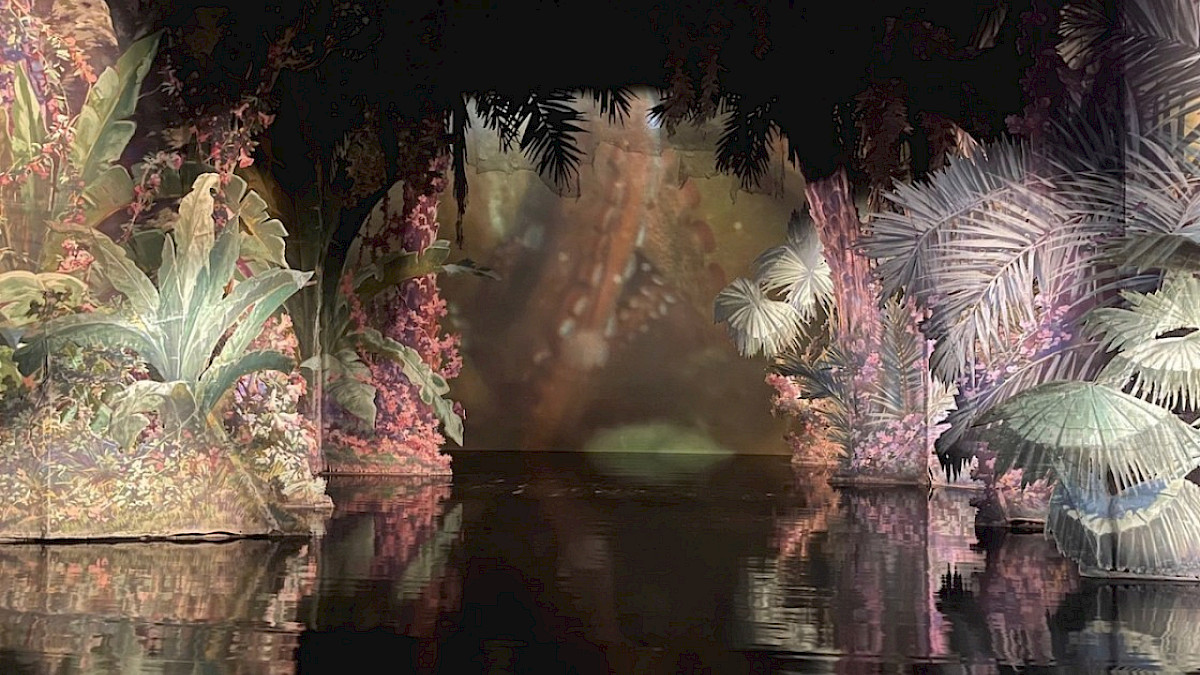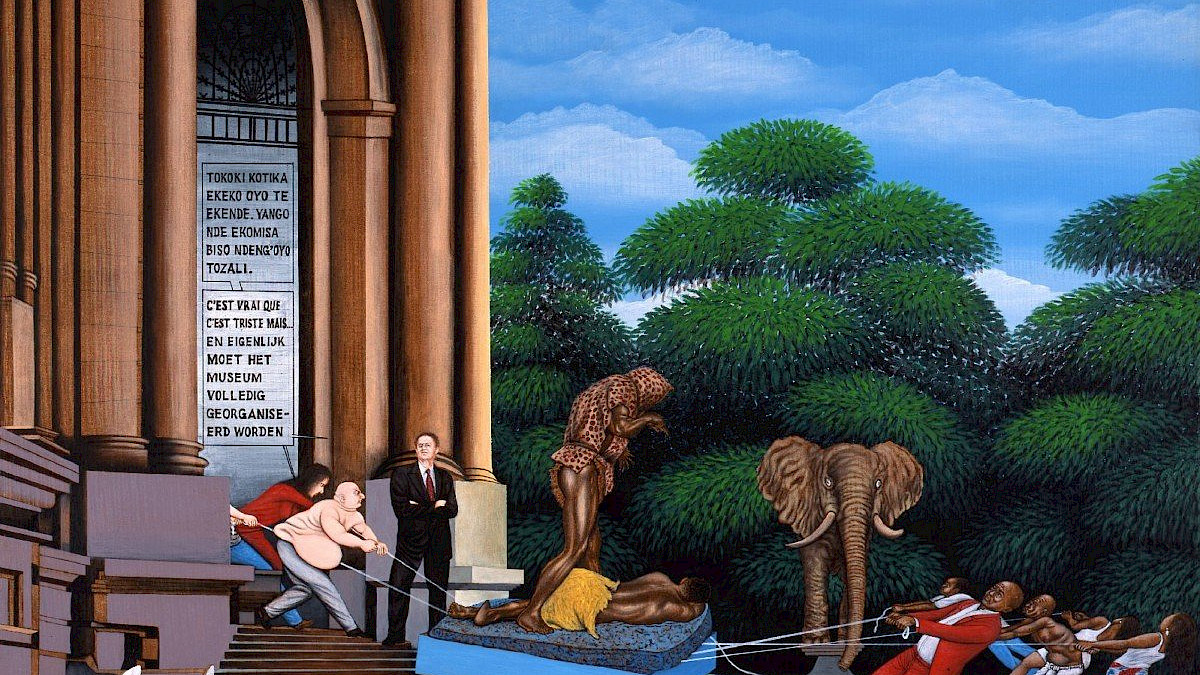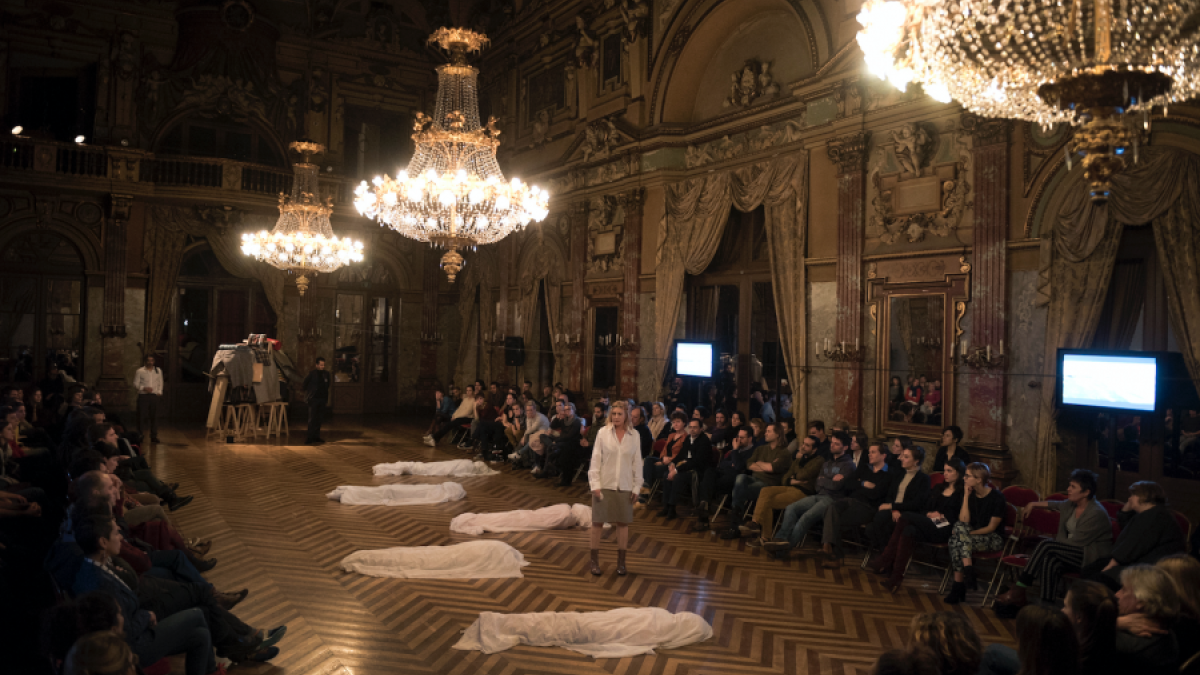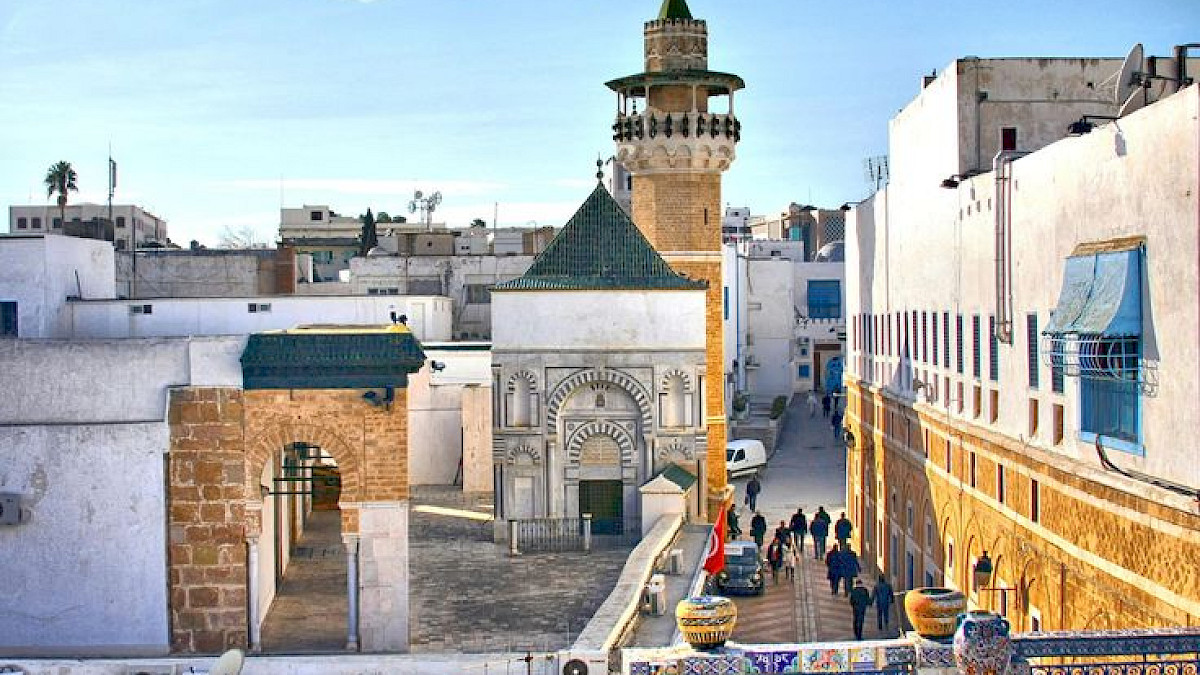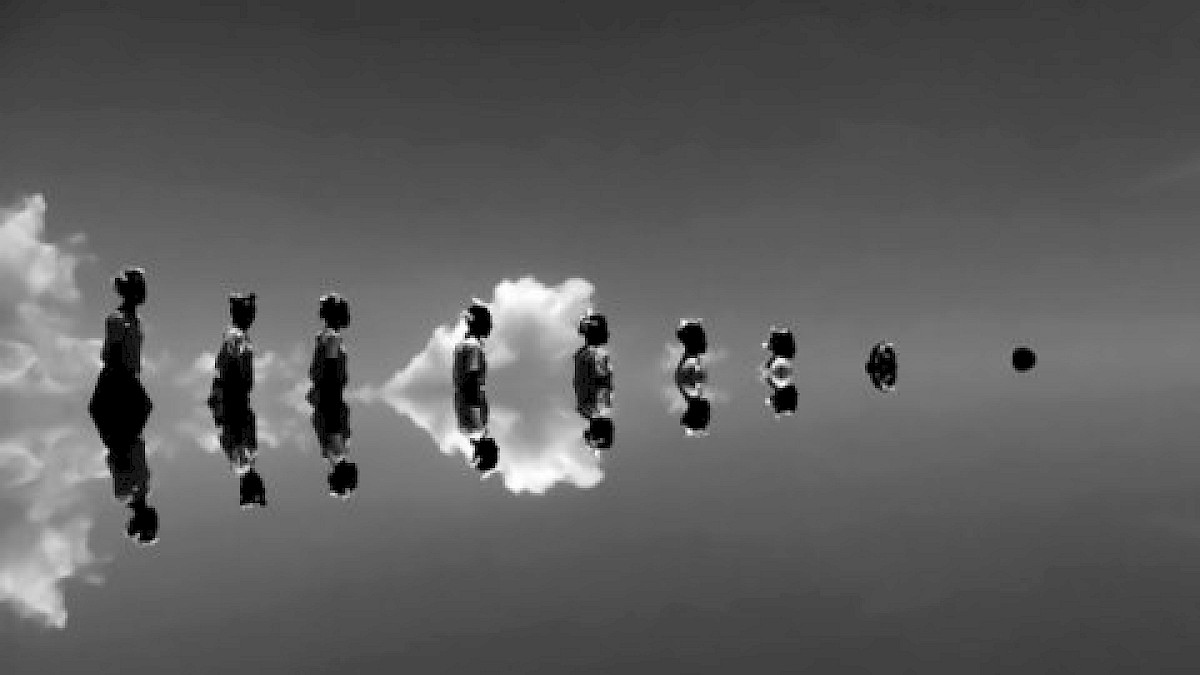
Mourning Images

© We Document Art
© We Document Art

A conversation with Rabih Mroué, in the frame of 'Images Mon Amour, his solo exhibition at Extra City, Antwerp (26.11.22 — 16.04.23).

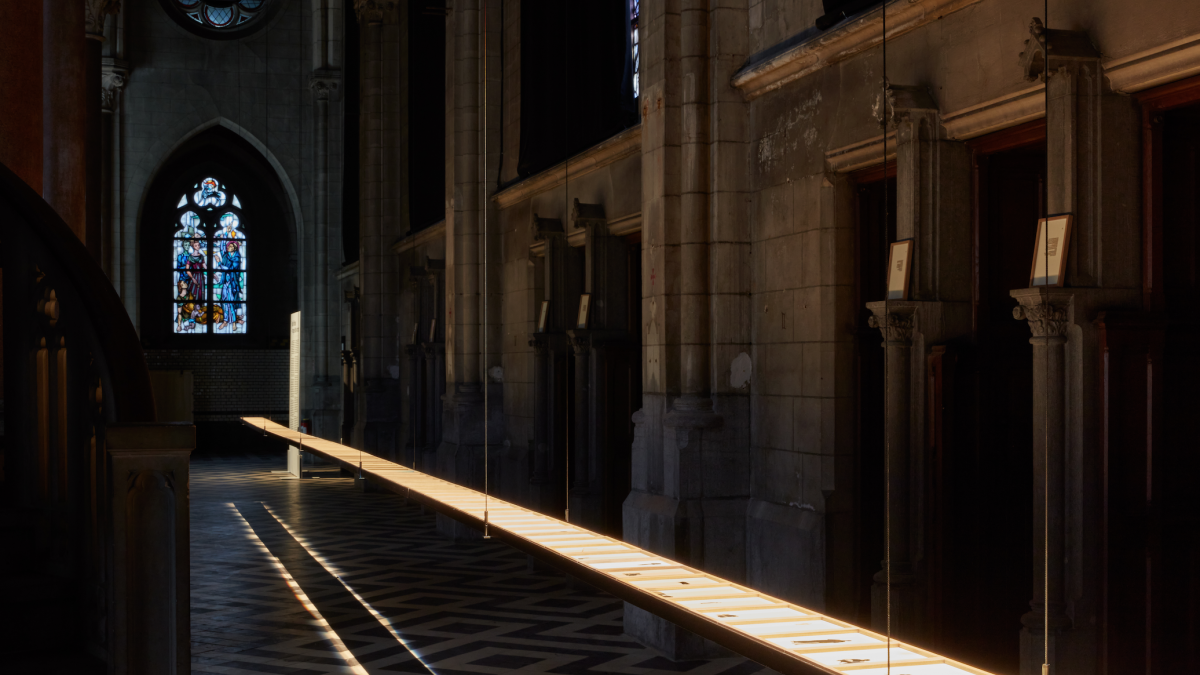
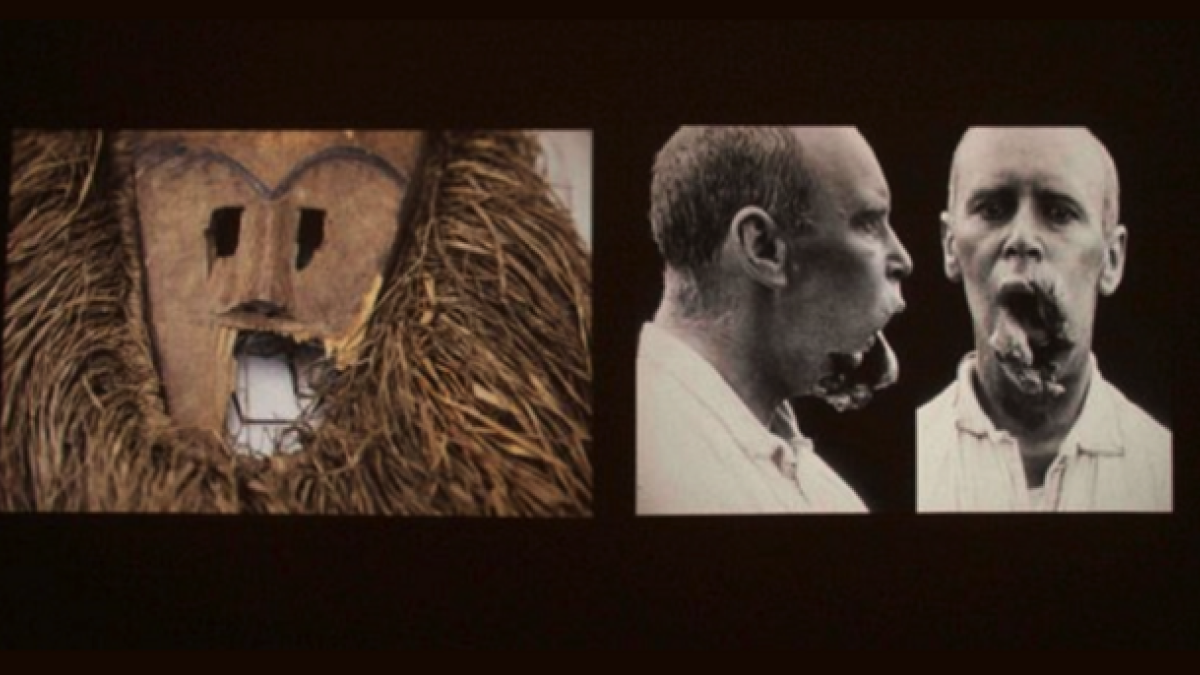
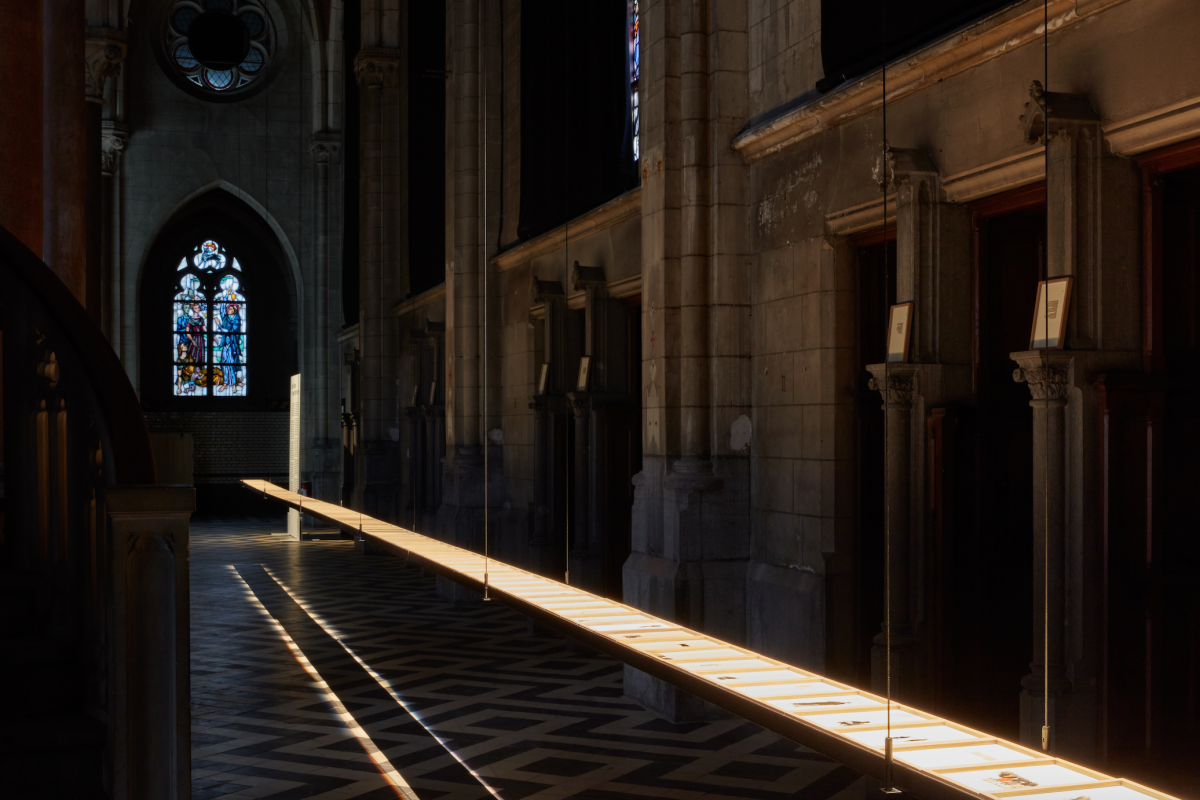
Rabih Mroué has been active for many years in both the fields of performing and visual arts. He built an impressive oeuvre challenging the limits between both disciplines in an ongoing artistic research on the mediation of images in times of revolution, devastation and war. For Images Mon Amour, hisfirst solo exhibition in Belgium, Extra City art center in Antwerp, brings together a fine selection of his work in a desecrated Dominican church, that together defy the ill-fated impossibility to escape the ever expanding, endless war and its unfolding catastrophe.

Ceaselessly grappling with the unimaginable root causes of the Lebanese civil war (1975-1990), he deconstructs the way in which truth is fabricated and remembered at different particular times and moments in history. Since 9/11, he is laboring the difficulties of translatability for western audiences, and anticipating different forms of appropriation by western media, challenging the autonomy of his work. In the fabricated shots and counter shots of the never-ending ‘war on terror’, both the distant and artificial image of the hero, and the embodied tangible image of the villain, mirror each other in their interminable representation of death, disaster and decay. Through an in-depth refection on contentious forms of image-making, he manages to anticipate the more generalized fictional and performative construction of reality in contemporary at times confusing post-truth politics.

Most of the works in Images Mon Amour are remarkably re-assembled images and drawing selected out of his archive, made of newspaper clippings, digital photos and stills collected between 2006 and 2016, from the Israeli invasion in Lebanon, to the end of the so called Arab Spring and the generalized internationalization of the war in Syria. Walking a thin line between the realist impulse and the fictional appeal animating his artistic research, he invites us to more sensuous ways of knowing and feeling the invading images of revolution, devastation and war. In this way he makes intimate what is rendered distant, and renders tactile what is made invisible, always sharpening the audience’s position as a witness, in what seems to be an alley without end.  

Haunted by different ghosts of enduring pasts, his work leaves us with a feeling of being stuck. Not only stuck in space, unable to flee the war, or stuck in time, carrying the weight to remember in our lingering desire to forget, but also stuck to one side of an image and its other. It confronts us with the powerlessness we can feel when daily scrolling on images of war and devastation on social media, overseeing the bigger picture, but also with the question how to relate to images dealing with the pain and death of others, without aestheticizing them.

Moving away from that question, scholar Ariella Aicha Azoulay proposes to get rid of the opposition of aesthetics and politics imposed by a professionalized gaze, that looks and judges the works of art at play. There indeed exists no image outside of the aesthetic plane. Politics can moreover never be reduced to a trait of the image itself. Azoulay then generously suggest to look at their reception, and approach images as spaces of appearance, where the possibility of public action resides. In the images rising out of the ruins of war and devastation in Images Mon Amour, an open encounter undeniably emerges, but an encounter not only between the different living beings animating the images at view, not only the object, subject and viewer of those mourning images, but also those that did not survive the captured catastrophe and devastation. That loving necro-political space of appearance, that endlessly renewed encounter then not only includes the living but also the often silenced witnesses of history, likewise always moving and making us move anew at any point in time, in unforeseen directions.


Rabih Mroué, Again We Are Defeated (2018), Images Mon Amour at Kunsthal Extra City

JBY: The venue of Extra City, the stunning but serene desecrated Dominican church close to the central Station in Antwerp, sheds an interesting light on your work. The architecture and history of the place accentuates the already very present and at times overwhelming feeling of mourning in your drawings and video’s. Even if it’s already desecrated for 20 years now, you feel it’s the right place to deal with images of devastation, death, decay and mourning so central in your work?

RM: Certainly, when you enter the exhibition you immediately feel the powerful presence of the Dominican church. But, a desecrated church is not an easy space to show you work in. It has already a strong identity in itself. The space itself carries a history and a strong identity. From the beginning I was challenged. How to deal with something as inevitably religious as a church. I come from Lebanon, a country marked by its civil wars, where religious differences play an important role in different conflicts and massacres between various confessional groups. As an atheist, I prefer not to deal with religion, I even have an aversion for everything religious. So, when, I first came here, I was like, really? Of course, my first immediate response was to attack the church, to make a proposition that would go against it. But then I decided it is better maybe not to. I worked on a proposition, that would just be with this particular space, without opposing it, without invading it with my work neither. I opened myself up to the venue as it is, without changing it, so it can host me as I am too. I did not want to change the church, nor the church to change me. The challenge was how to accept each other. The church is worn out, it has a lot cracks and fissures in the floor and on the walls, this decay also resonates with some of the themes I relate to in my work.

JBY: When we enter the church we are welcomed by the work “Again we are defeated” where projected drones hoover above sketches of silhouettes or shadows of death bodies on paper. In the confessional a bit further in the church, you also share with the audience how defeats, unlike victories do not accumulate. From one angle you show how defeat is always bodily, inescapably lived in the flesh through the finitude of our life, whereas on the other hand you render visible the lethal technological calculated gaze of the perpetrators.

RM: Even though there is something playful in the title, it almost speaks by itself. There is indeed something in its repetition. It is not the first time we are defeated, and it looks like it will not be the last time neither. In one of the 6 audio-works that I placed in the different confessional booths, I am not only sharing the insight that defeats do not accumulate like victories, but I also confess that I have never managed to be the first, nor have I ever succeed to be the last. But, I am and will always be late. Moreover, I will never manage to be in the middle. So, again we will try, even if we know that we will be defeated, we will try. We will be defeated, but we will try again and again. So with this title, I want the hope to never die.

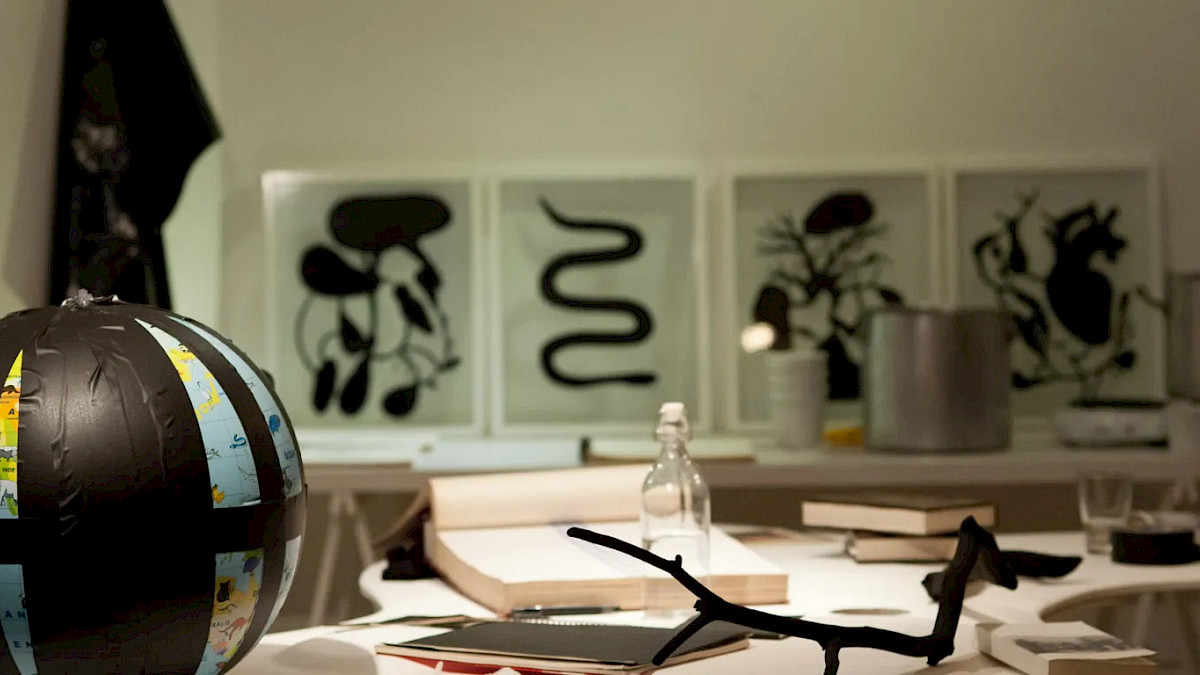
The installation is using these two media together. So the video of the drones is projected over the drawings on the wall. There are about 112 drawings of different corpses. All 112 bodies are killed, someone actively put an end to their life. They did not die a natural death. In Lebanon, or Syria for that matter, there is no justice for most of the people killed, I can even say for all of the people killed.  It’s always “case closed”. Wiped away, hidden, and denied any acknowledgement. Nobody wants to talk about them. Authorities often want to hide the corpses, because they are complicit in the massacres and war crimes. But when they try to hide the killed bodies somewhere in the ground or in the sea, they always forget their shadow. I am trying to draw with my pencil this shadow that stays, as a trace kept by those whose life are taken. The projected drones are lethal killer drones, but with the size of flies. So the first impression I want to give from far when you enter the church, is the impression of a drone massacre. The drones are hoovering like flies over the massacred people.

The calculated gaze of the perpetrator relates to a question of representation. Peter Brooks, the theater maker, always asked this brilliant question. How many trees do you need to represent a forest on a stage? Three, ten, a hundred? You can simply choose to just write “forest” on a paper and the spectators will immediately imagine a forest. So the word will represent the forest. Then, when you want to represent a massacre or a war, the question is not how many elements you present, but how you present them.

Like in ‘As if seen by a bird standing on the top of a cow’ you make the visitor look up and in a way look back at the drones constantly watching over some of us.

RM: When drones film, they do so through the bird’s eye perspective. So imagine now that the bird is on the floor, or on the top of the cow if you like, and looks upward. In this installation I simply flip the gaze, which allows a shift from looking down, to looking up. In the same gesture, I also flip the imaginary of the land, so the sky comes down and the ground with its destroyed ruins rise up, above our heads. So the sky transforms into a ruin in a way.

JBY: After passing by the 112 drawings, we are invited in the exhibition space through a movement in perspective enabled by the way you installed your work. Slowly walking by the different images composing your ‘Diary of a leap year”, the drawings are leading us to two different videos shifting our perspective. In ‘The Other, the Unknown Other and Other Stories” and ‘Too Close Yet Inaccessible’, the viewer has to stand still and watch the images strolling by this time. The contrasting play with movement takes the viewers not only into the exhibition, but also into a movement of flight, seemingly fleeing along the devastation and war depicted in your drawings and collages.

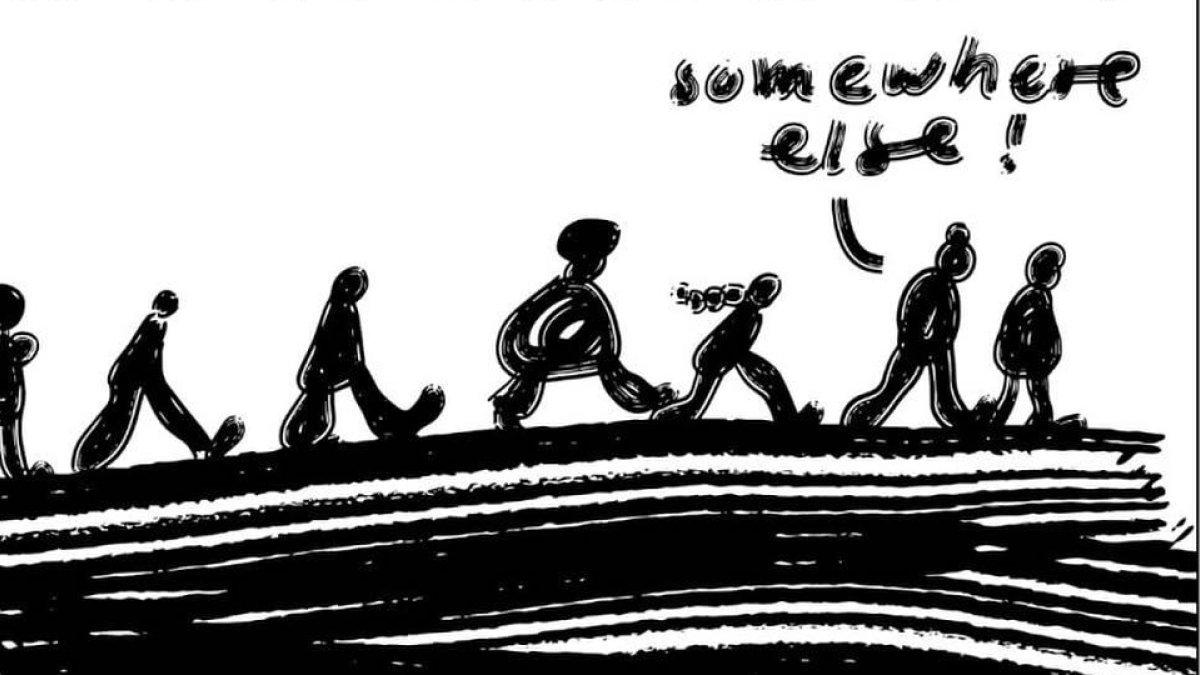
RM: We always try to run away from our realities, dominated by conflicts, wars and violence. We try to escape, to run away, towards a better, more peaceful life. Unfortunately this fleeing is often in vain. We are running all the time, but remain stuck in the same place, in the very ruins, the rubble itself. Alas, you cannot run away from your reality. It’s impossible. So you imagine another life, the life that you would like to have. At times you can sense it close by, but it will always remain inaccessible, unconceivable, unattainable, and unreachable.  

Also for the collages in “Images Mon Amour” I show people always ready to leave, with their most treasured possessions in a luggage wrapped over their shoulder. They want to go, they want to leave but there is no way out. They are stuck in the ruins as all the means of transportation, like ships, planes, trains, are there, but broken so they cannot use them. We always try to run away from the things we should face. Maybe we simply should not run away, so we can try to face our reality to solve it. No, we are running away instead, hiding the things we want to forget.

JBY: But fleeing is also imagining a different possible outcome, a way out of the devastation and the endless war. Your implicit reference to Hiroshima points not only to this haunting prospect of complete annihilation, over different scales and geographies resulting in a global no place of sorts, but also to the complete destruction of any future perspectives. Your work seems to surpass the simple dichotomy between optimism and pessimism, by simultaneously confronting the limits of both. But I cannot but to mirror or reflect back the devastation, the loss of perspective in the images you show.

RM: You are maybe right, it is not about optimism or pessimism. When you enter the exhibition, there is something emotional, almost physically about the more abstract work that takes you at the beginning. But then little by little, the presented works create a little more distance. So they give you more space to think what all these images, drawings and sketches are about and the question they pose. These questions bring you slowly to the last room which is dedicated to the videos of my non-academic lectures. They really offer the audience material to think about and ask more concrete questions and issues. No, it’s not about optimism or pessimism, nor about conclusions and answers. My proposition is all about unfinished ideas, unfinished work also. I want to keep a form of incompleteness that still needs the spectator, needs the audience to add to it, because it is always a shared incompleteness.

You seem to defy us with the inescapability of an ever expanding war, stuck not only in space but also over time. In ‘The Other, the Unknown. Other and Other Stories’ you share with the fictional character of Corol, the impossibility to leave Beirut, even when visiting other cities, as you always seem to be haunted by ghosts of a past that you thought you had lost or forgotten.

RM: The feeling of being hunted and haunted. Indeed you run away from your place to actually find it back differently. And you run away from your city to find it in another city. You find your city in another city, you go to another city to discover your city. You go to another place to discover your past, to remember your past. And also, moreover, sometimes you go to another city to see the future of your city, even to see the past, present, and the future at the same time.

Rabih Mroue, Images Mon Amour (2021), Exhitbion view
Images Mon Amour at Kunsthal Extra City (c) We Document Art

JBY: Installed in the high ceiling of the church, the video ‘Images mon Amour’ acquires almost a celestial reach. The slow version of Mozart’s requiem playing on a music box in the background, accentuates the deep scroll, showing in a long, ascending movement a thick collage of devastating images selected from your archive, made of newspaper clippings, digital photos and stills you collected.

RM: Indeed, the form of the installation is inspired by the way we use our smartphones, where we always scroll for news. We are drawn in an interminable stream of images, that seems too go on and on in a never ending movement. At some point, you put it away, because you’re tired of it, but the steam of images continues. It’s the same idea with ‘Images Mon Amour’. It has the form of a screen, and like the scroll, it goes on endlessly. It gives you the impression it goes on for forever. The images of violence, the violent images and the images of wars and catastrophes come and invade our eyes and our minds daily. We cannot run away from them. They are coming forever. So how can we digest these images, how can we deal with them, how can we continue our life while faced with this continuous stream of images. The presence of the geological layers, the sky and the sea show us the depth of the scroll, but also of history and its desolation. It’s not about 2006, nor is it about 2016 or 2020. It goes deep in our history as humans, already since thousands of years we are waging war after war.

JBY: In your non-academic lecture ‘On Three Posters’, you tackle the problem of translatability, as in the post 9/11 era you work was received differently depending on the context where it was shown. When seeing the installation ‘The Mediterranean Sea’, I directly thought how in 2011 people risked their life to reclaim their right to international mobility, the right to cross the Mediterranean. When you look at it from Palestine, Lebanon or Syria, instead of North-Africa, the dead body floating on the sea maybe has a different meaning?

RM: The sea keeps a lot of secrets. It swallows a lot of people too. Indeed the video installation is not only related to the movement of refugees now. Especially today, from Lebanon and Syria, people risk their lives by boats. They are drained and killed by the sea. The sea gulped them, took their souls. But also before, during the civil war in Lebanon from 1975 till 1990, the corpses of the committed massacres, were thrown into the sea. So the sea transforms into a sort of symmetry of mass graves. We have about 17,000 persons missing until today. Maybe they are somewhere on the bottom of the sea? Are they really still missing? We don’t know where they are. The corpses did not appear until today. Moreover, nobody from those responsible, who are still in power today by the way, take any responsibility. They won’t tell us what they have done to those missing. The sea hides something really violent inside. At the same time, the sea always holds a semblance of a promise, the promise to take you to somewhere else. Like a horizon. So if you can safely cross the sea, you cross the line of the horizon, and you will probably have a new life after. But too many people did not make it.

JBY: At the same times the waves of the sea give and impression of cleansing, washing away whatever that needs to be washed away, as a form of purification. It endlessly washes away our crimes too, like the church washes way our sins maybe?

RM: This is what the church supposedly does, yes. Like in Islam, when you do the Hajj, the pilgrimage to the holy city of Mecca, you also wash away your sins. To me, it is a senseless idea, very similar to confession.  At any time, whenever you think it’s the right moment, you would be able to wash and purify yourself, to start your life anew. You can turn a new blank page whenever you feel like. This is also exactly what happened in Lebanon, when they decided to stop the fighting, to stop the civil war, they also turned the page, and decided not to investigate the reasons of the atrocities, not to open investigation files or start juridical cases. They had the feeling it was enough, so they turned the page as if nothing happened. So they were no criminals, no perpetrators judged, we were suddenly all pure and innocent again. So we start anew from the beginning, just because we decided so. What is this hypocrisy? What is this lie? As long as we keep on turning the page, we are perpetuating war, which keeps on continuing, war after war, like nothing changed. It’s very similar as going to the church convinced God will forgive you for your crimes, and you come back and go on with your life happily, but it’s not true, it’s more complicated.

JBY: It reminds me of your installation ‘Eye versus Eye’, the double shot. Where you engage into an almost forensic investigation to render the face of a perpetrator visible to hold him accountable, for his sin of protecting the Assad regime during the Syrian war. Through this endless spiral, going from the image of the eye the victim filming and the eye of the culprit shooting, you humanize the victim, and simultaneously unmask the perpetrator. Like most of your work on show, the endless loop holds the viewer in suspension, waiting for the shot to happen. But like in a cowboy duel in a Western, you know the shot will come.

RM: Yes, I call it the in-between state. In that twilight state there’s something happening in our relation to place and time that is fundamentally different than the relation we experience in our daily life. So it’s these moments where your experience the elasticity of time, when minutes could be hours, could be days or even years. During this moment of eye contact between the killer and the victim, time and space shift to another logic. Nothing will cut the spiral, and bring it back to the world of the living, except the bullet, the shot, like the cut. Without the cut, it will remain an endless loop. So they are stuck. For us, it’s suspended. But for the one who is in this moment, filming the one who will shoot him, he or she will be in a different space, in a different time, in a different logic.

JBY: Indeed, they keep on filming, even though they know it will probably end there for them. But hopefully they survived the shot, like you said in you non-academic lecture ‘The pixelated Revolution’, because someone had to upload the video in the end.

RM: What is intriguing is that the victim is always off screen, it is only the movement of the camera and the sound that we understand the sniper shot him. So, we never see the corpse, we don’t know what really happened to the protester. Did he die, injured, managed to escape? The only thing that we know for sure is that his video has been saved. We have seen it uploaded on the Internet.  But still in the video, we don’t see the face of the victim, we don’t see any blood. There is nothing. When we try to imagine what might have happened to the protestor when he was shot, it becomes almost unbearable. The violence is in our mind.  My question then is how can we bring the victim as a witness in the image, how can we imagine the witness that is being shot, not in a Hollywood way with a simple shot/countershot, but in the shot itself? Since there is an eye contact between both, the only way out is to blow up the eye of the perpetrator, to see the reflection of the victim in his eye. Victims have the image of their killers left in the eye. This is one way to bring all the victims into the image.

JBY: Where as in the overall show ‘Images Mon Amour’ a fatalistic sentiment seems to prevail, in ‘I Swear with Fire and Iron’ we can feel a sense resistance. While watching a hand struggling, being forced into and released from what seems to be a torture or at least a disciplining instrument, we listen to two different versions of the same communist refrain, both song by your brother Yasser, before and after he was hit by a bullet during the civil war. The effortlessness your brother sings the song, speaks as much to the fixity, reproducibility and disciplinary effect of the communist song as to your brother his resilience despite the unfortunate communication disorder he got after being shot during the civil war. It might be contradictory, as singing this song will not stop the war, but I found hope and the possibility of repair and resistance in this work.

RM: The question is really how this ideological narrative enters into people’s minds. When a child sings a revolutionary song, he embodies a very violent narrative by singing the will to fight until the very end. That little boys sings that if he loses his hand, he will fight with the other one, and if he loses both, he will use his teeth. He’s just singing it as a normal song. If someone knows Arabic, she/he will notice there are a lot of words the boy is mispronouncing, so you understand he doesn’t fully grasps the meaning of the lyrics. After he got shot during the civil war and indeed became aphasic, another difficulty with language emerge. When singing the same communist song, he loses some letters, and mispronounces other words. So now, it’s the opposite, he knows what the song means, but he cannot sing it correctly anymore. When listening to him sing, we see his hand, which is now taking another form, another position, constantly being correct. Training, almost disciplining his hand with this wooden medical tool, forcing him to open it and put all five fingers in the right order, straight and open. But will it allow his hand to move like before?
Ahl El Hijra - Qu'est ce que se passe-t-il a Schaerbeek?
What's Happening in Schaerbeek?

14-10-2025
Articles
Bruxelles
Maghreb
Mustapha Bentaleb
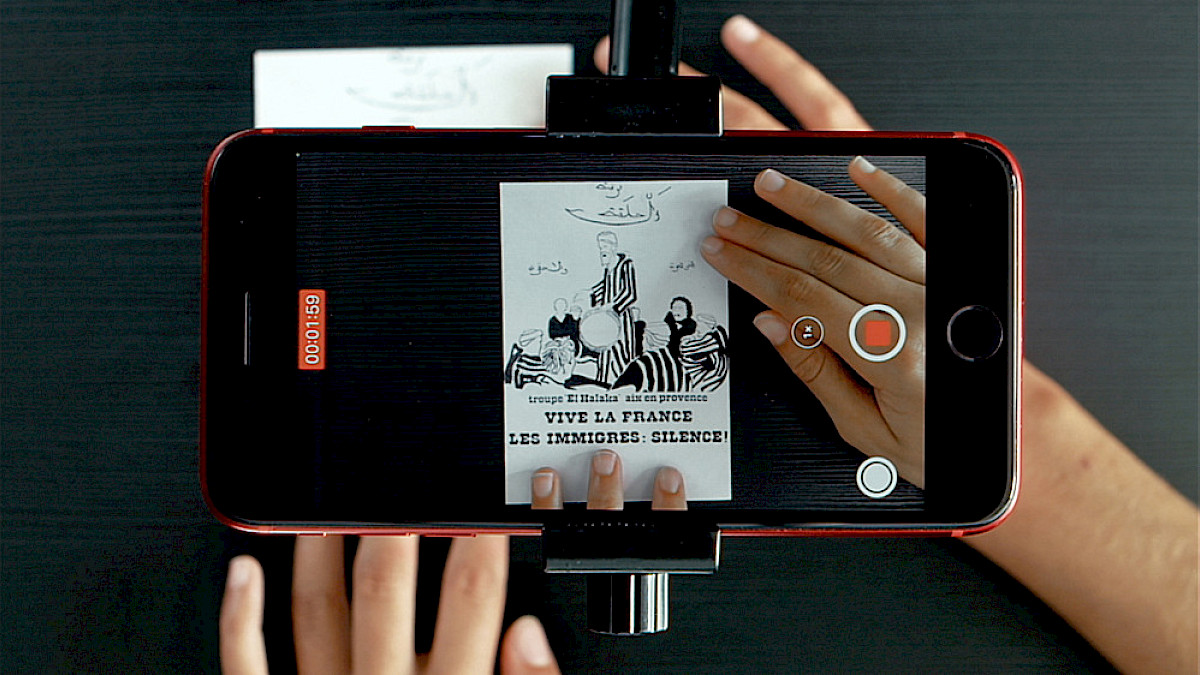
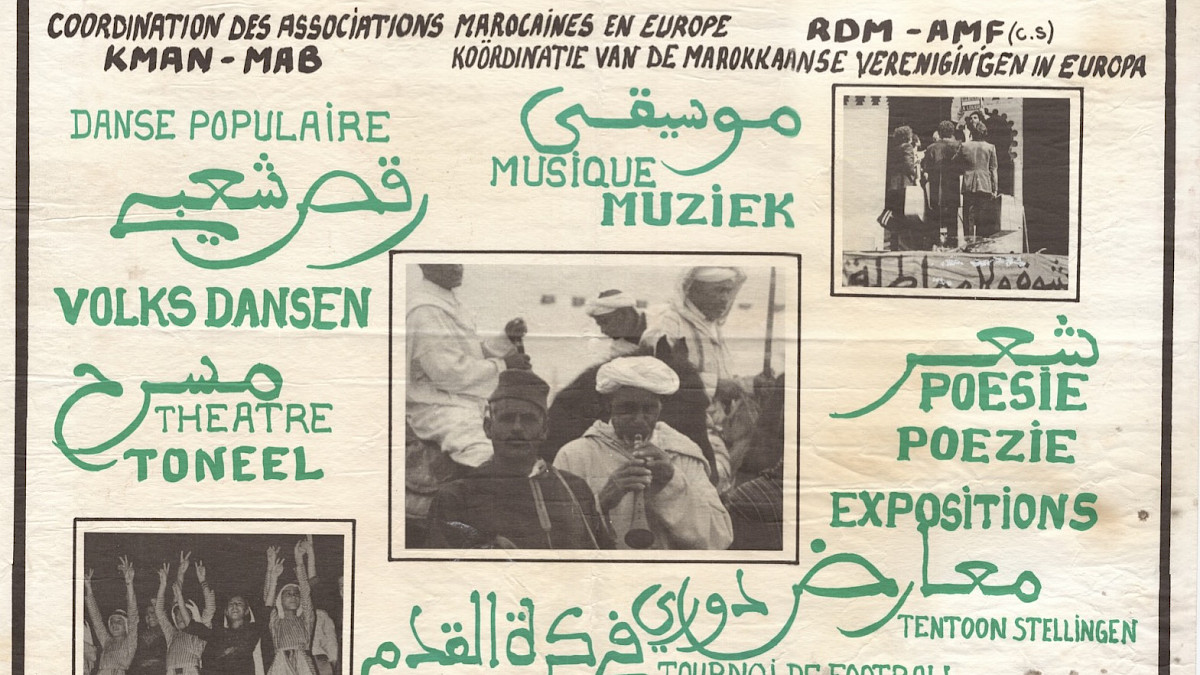
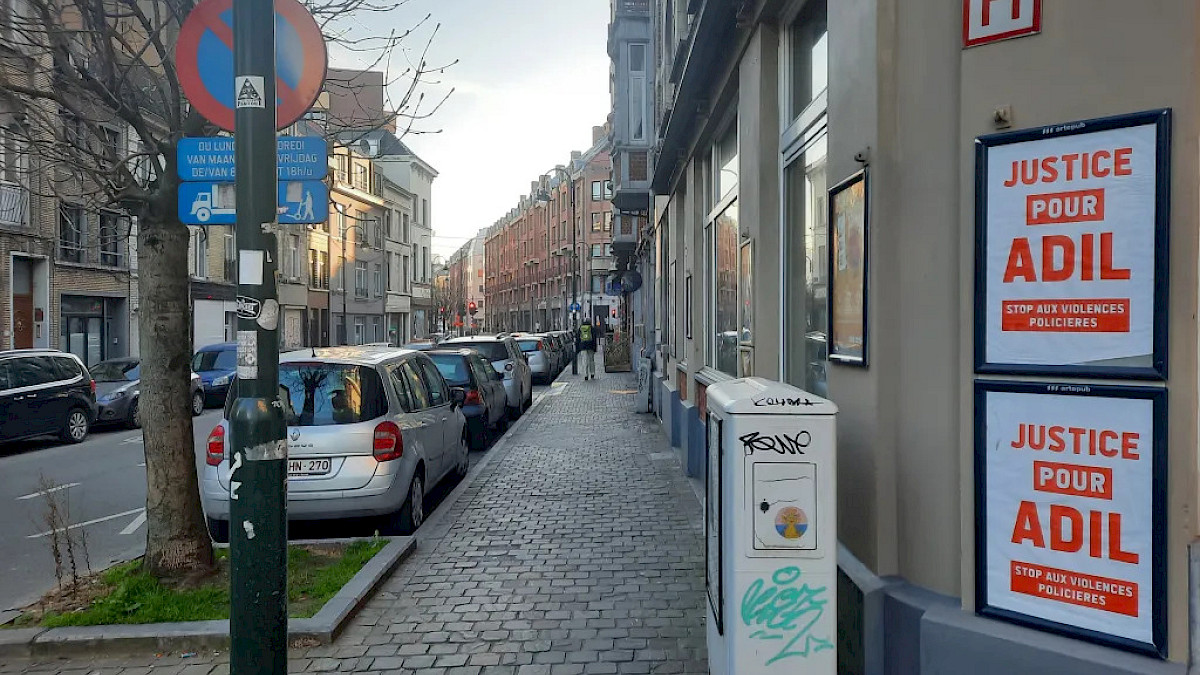
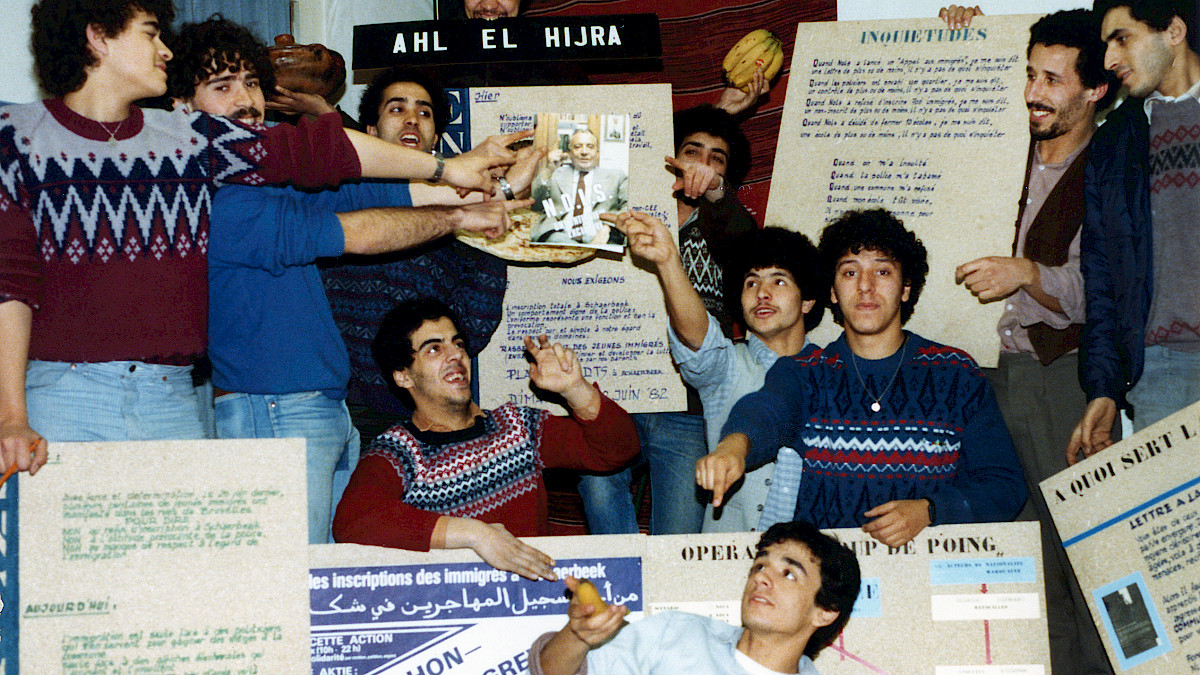
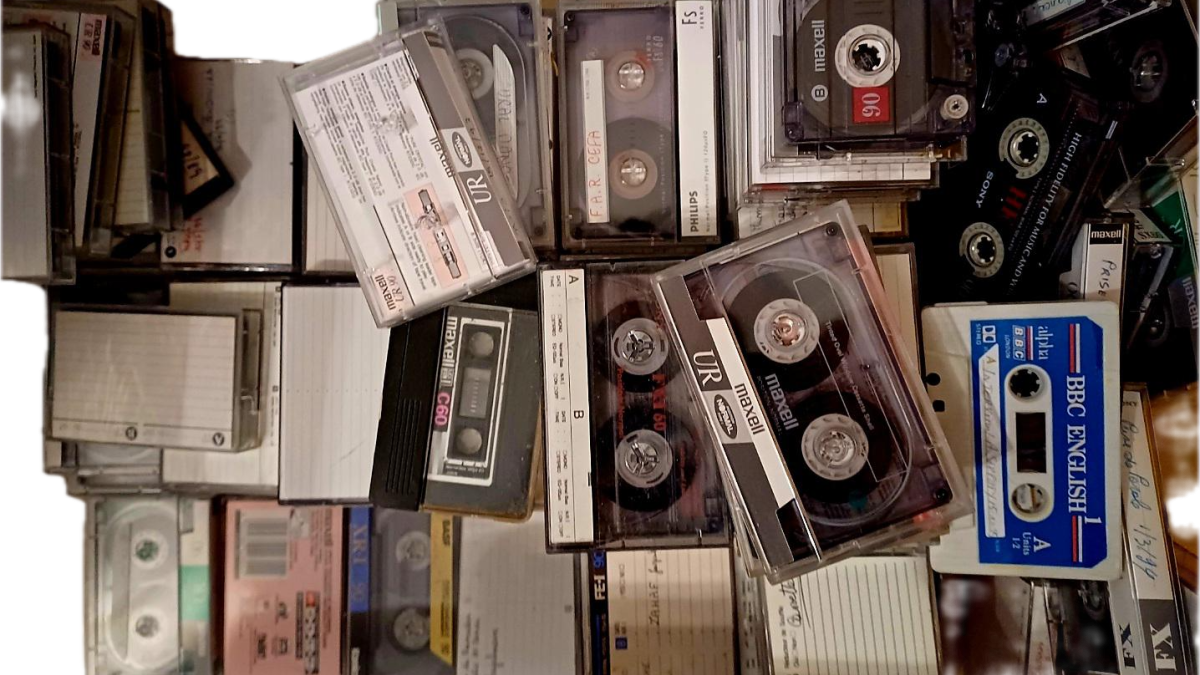
As editors, we arrived at this contribution by Mustapha Bentaleb and Joachim Ben Yakoub somewhat like latecomers to a gathering, where a conversation is already unfolding, photographs are being passed around, and old songs still linger in the air. What we encountered was not a linear narrative, but a constellation of memories, documents, names, and voices—partially preserved, partially reconstructed. The setting is a contemporary collective workspace in Brussels, known as The Kitchen. There, the authors imagine a gathering with members of the former cultural-political group Ahl el Hijra, sharing yellowing photo- graphs, leafing through copies of Tribune Immigrée, and reflecting on acts of resistance from early 1980s Belgium. This layered return—across time, media, and memory— invites us to consider not only what remains of these histo- ries, but how we reassemble their fragments in the present. At the heart of the story is Schaerbeek, a working-class district in Brussels where many Maghrebi workers settled following the 1964 labor agreement between Belgium and Morocco. In 1982, under Mayor Roger Nols, immigrant residents were systematically excluded from the municipal registry—cut off from basic social rights such as legal recognition, welfare, and access to schooling. In response, Ahl el Hijra launched a series of actions: a hunger strike, public gatherings, and a collectively built exhibition titled What’s Happening in Schaerbeek?. This contribution returns to that moment, by allowing fragments to speak. Archival photographs, interviews with a former member of Ahl el Hijra, pages from Tribune Immigrée (Issue 4, Feb.–Apr. 1982), and the protest song His Imprisoned Shadow converge to form a scattered composition ... What follows is not a definitive account, but a listening position, attuned to what surfaces when the past is reopened in the present. Taous Dahmani & Tom Viaene
Atef Maatallah

Monumental Re-Bourguibization

23-01-2025
Papers
Atef Maatallah
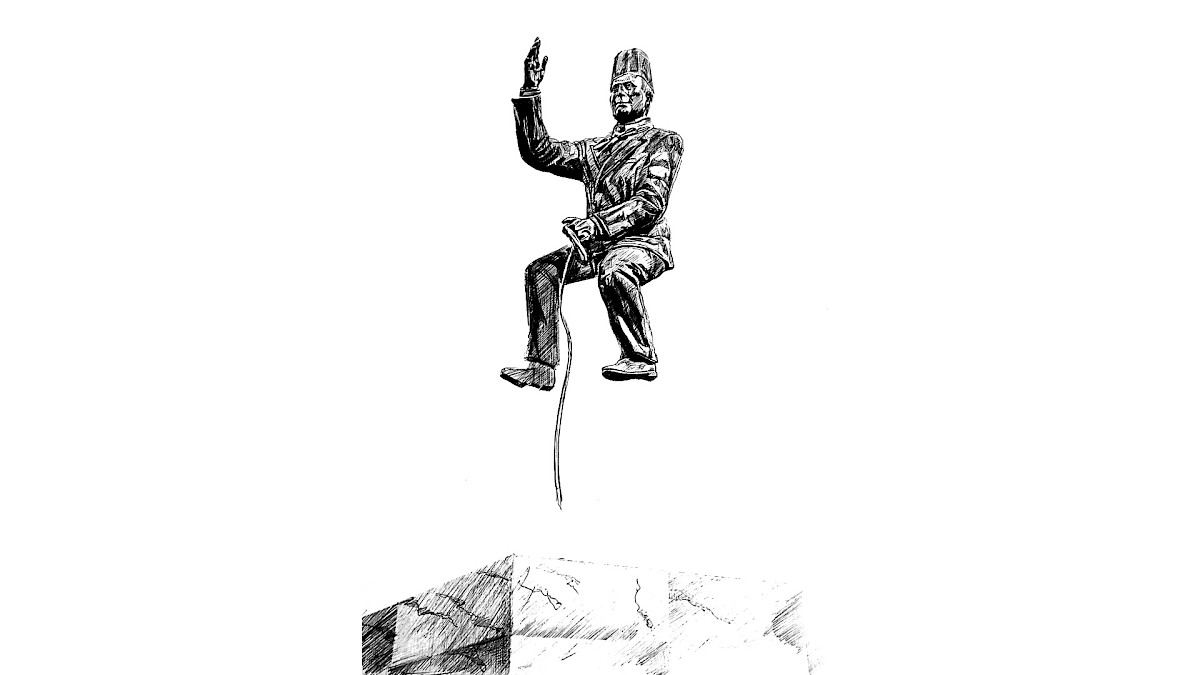
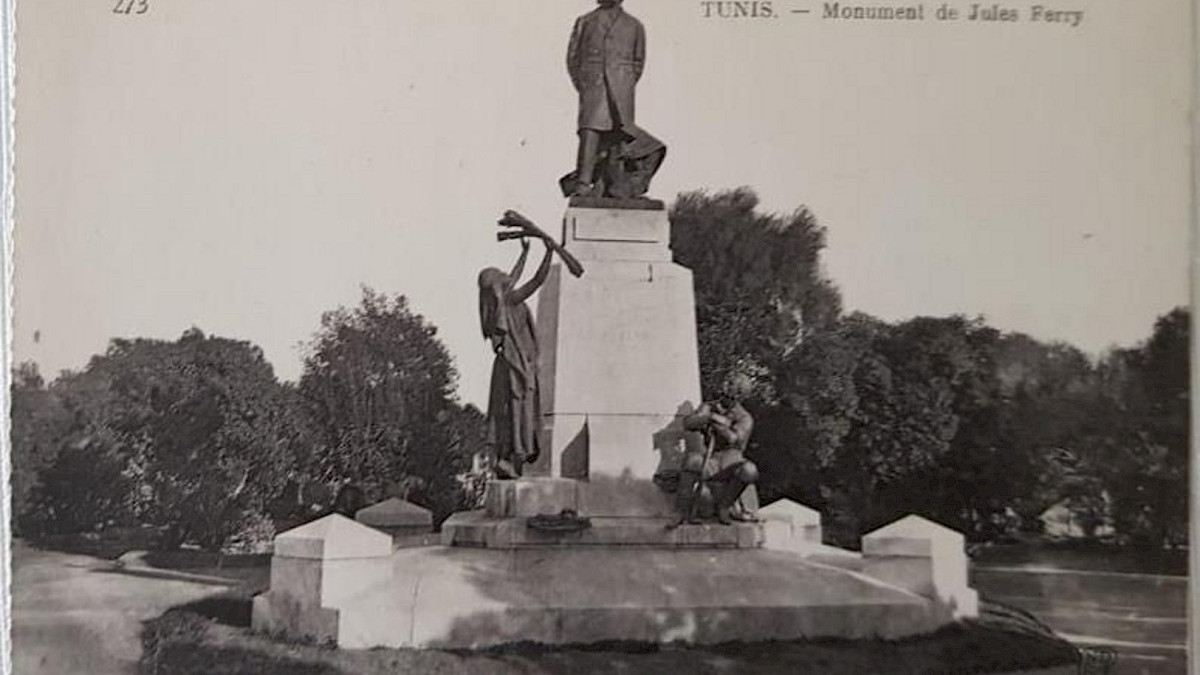
In January 2016, the first President of post-revolutionary Tunisia, Beji Caid Essebsi addressed the people, from exact the same setting as former president Habib Bourguiba’s in January 1984’s speech to contain popular revolts. In the proposed book chapter, I venture into the power dynamics proper to the constitution and reconstitution of state aesthetics in the process of monumental re-bourguibization. As the appropriation of spectacular power in different cities over Tunisia such as Sousse, Monastir or Tunis, was met with new waves of artistic resistance, my contribution to the book takes notice of the often-overseen processes through which aesthetic agency was temporarily halted by the re-emergence of new forms of authoritarian symbolic politics during the post-revolutionary phase. Based on a long-term participant observation in the field of visual arts in Tunisia between 2011 and 2017 and combining insights from aesthetic theory and various postcolonial critiques, I show how monumental aesthetics are not structured overnight. Looking into the formation of spectacular power in the longue durée, I argue that the thousand eyes that constitute contested monumental aesthetics in Tunisia are historical constructions, characterized by a palimpsestic structure that reveal its postcolonial disposition. This historically detour helps to untie the present apparent contradictions proper to the ambiguous processes of monumental de-bourguibization and re-bourguibization. Through the self-conscious, ostentatious, and aesthetic gesture of over-writing one symbolic order by another, the site of former colonial and postcolonial power is marked with at times opposing narratives and counter narratives of national becoming, forming a renewed, multilayered but contested site of postcolonial spectacular power. Published in the volume Art Against Authoritarianism in Southwest Asia and North Africa, edited by Tijen Tunali and Josepha Ivanka Wessels (I.B. Tauris, 2025
It's like a Finger Pointing a Way to the Moon

It's like a Finger Pointing a Way to the Moon

18-04-2024
Projects
Bruxelles
Tsumkwe
Moya Michael
!Amace
Be
Victoire Karera Kampire
Simon Thierrée
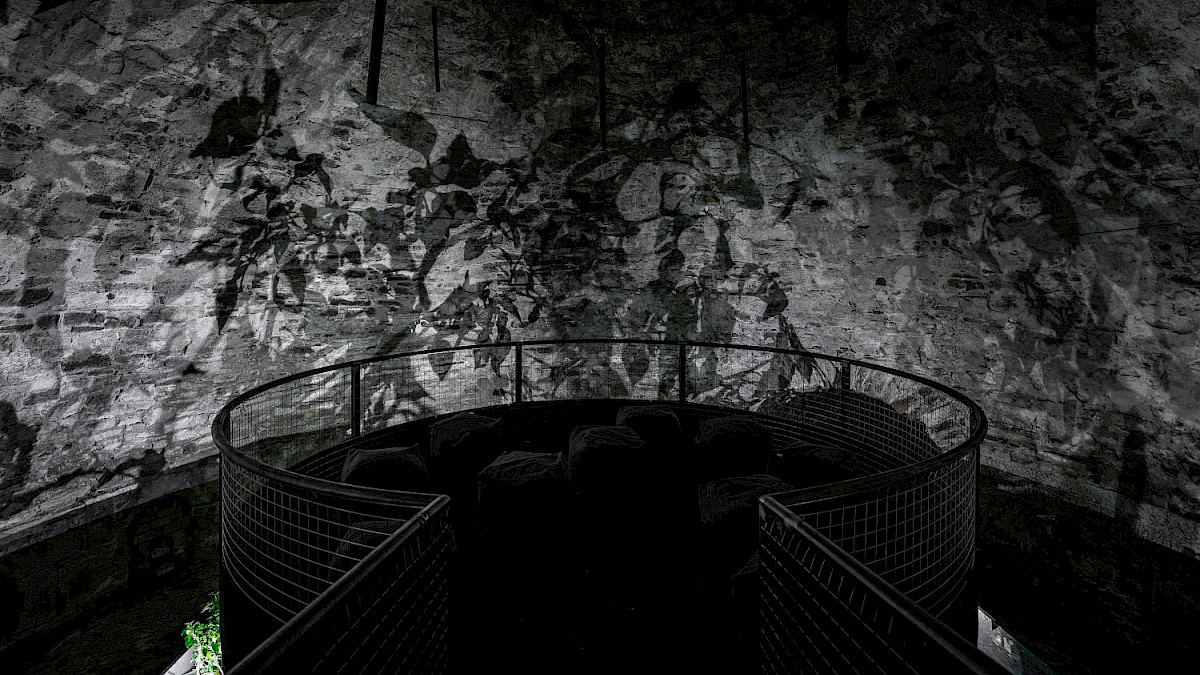
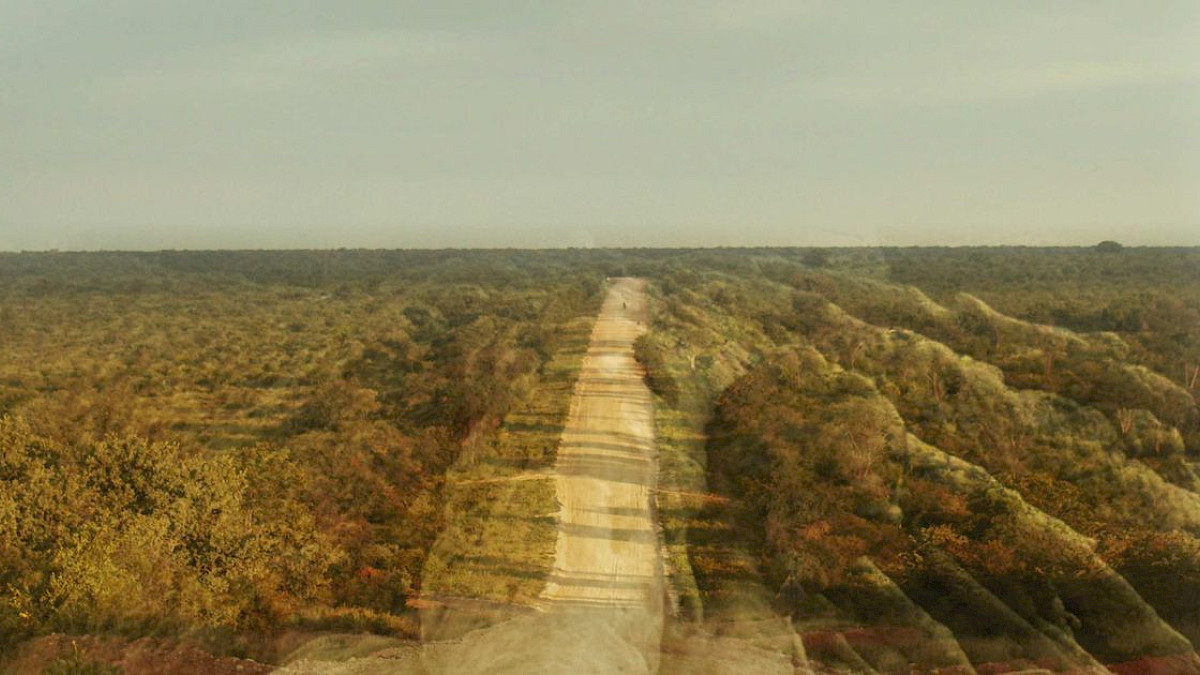
In It is like a Finger Pointing a Way to the Moon Moya Michael is searching for the movement of different unyielding languages. After the celebrated Coloured Swan trilogy and Outwalkers, choreographer Moya Michael proposes to dance nearby the guardians of words, movements, and rhythms she encountered in South-Africa and Namibia.  Drawing inspiration from Bruce Lee’s famous line in Enter the Dragon—“Don’t concentrate on the finger or you will miss all that heavenly glory!”—Moya Michael sets out to explore the worlds of words, movements, and rhythms she encountered in South Africa and Namibia. After spending time with !Amace, Be, and their Ju/'Hoansi family, she joins forces with artists Victoire Karera Kampire, Simon Thierrée, and Joachim Ben Yakoub. Through the precise use of image, movement, and sound, a liminal space of ongoing transformation is created, inviting reflection on oral tradition and survival. Together, they delve into the movement within different unyielding languages. Guided by Bruce Lee’s allusion to an old Zen Buddhist wisdom in his seminal film Enter the Dragon, “Don’t concentrate on the finger or you will miss all that heavenly glory!”, she proposes to move with what we cannot fathom. To disappear in order to preserve the words that precede us, that never left us. To transform in order to keep what came before us.   CREATION Moya Michael IN COLLABORATION WITH Victoire Karera Kampire, Simon Thierrée, Joachim Ben Yakoub SCENOGRAPHY Špela Tušar COSTUME DESIGN Andrea Kränzlin VIDEO Victoire Karera Kampire SOUND DESIGN Simon Thierée LIGHT DESIGN & DIRECTION Ellie Bryce SOUND Patrick Van Neck DRAMATURGY Joachim Ben Yakoub STAGE MANAGER Caroline Wagner PRODUCTION MANAGER Lise Bruynseels  DISTRIBUTION Cecilia Kuska PRODUCTION KVS COPRODUCTION WIELS, Perpodium, Bergen Kunsthall       
The Question of Funding

[Kitchen Broadcast] On ways of hosting, (under)commoning and insituting otherwise

01-06-2023
Conversations
Palestine
Bruxelles
Belgrade
Ramallah
Bojana Cvejić
Yazan Khalili
Reem Shilleh
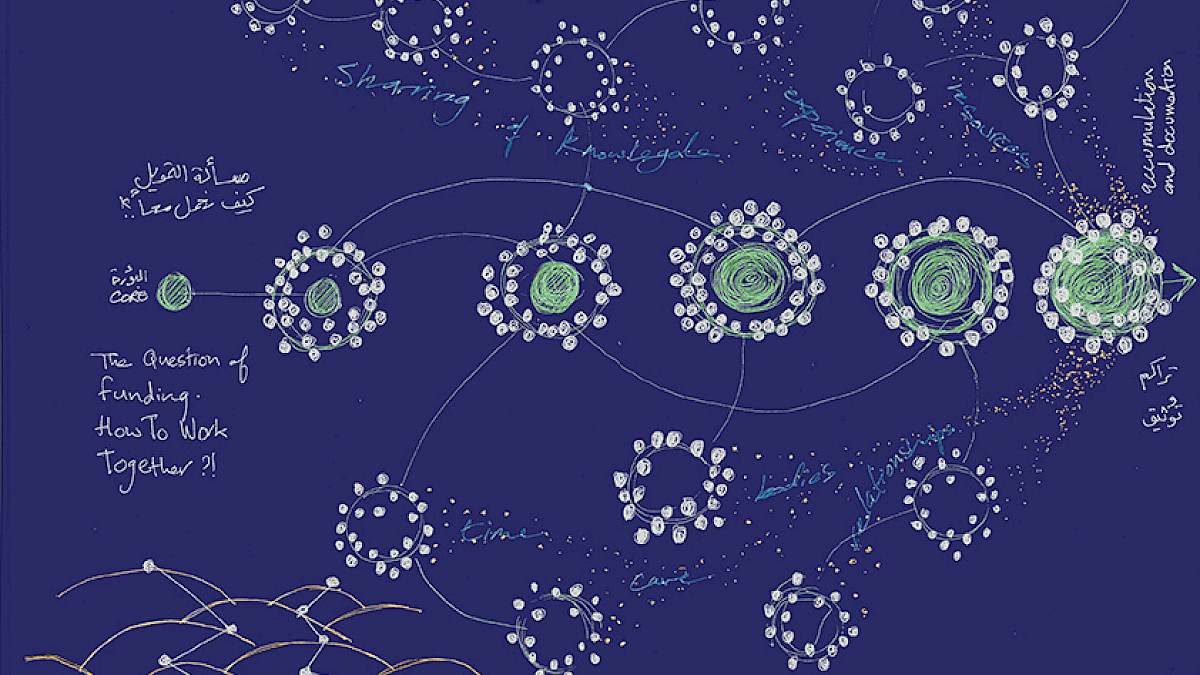
For the fourth episode of Kitchen Broadcast, we had lunch with Bojana Cvejic and Yazan Khalil and took the time to talk and exchange ideas about the infrastructural conditions and ways of hosting, (under)commoning and insituting otherwise, starting from both their practices in setting up different spaces and places. Bojana Cvejić is on of the co-founders, together with Jan Ritsema and still an active member of PAF (Performing Arts Platform)a residency in a small villange St Erme in France close to the Belgian border. She is also, among many other things, active in TkH (Walking Theory platform) an independent, institutionally non-aligned, extra-academic platform for performing theoretical-artistic activism. Yazan Khalili engaged in the transformation of Khalil Sakakini Cultural Center in between 2015 and 2019 in Ramallah, Palestine, and continued his reflections on processes of instituting through different projects, among many other things, the QAF or the Question of Funding and Aka, a space hosting a decentralized network of self-organizing and grassroots collectives in Kassel. Kitchen Broadcast is an ongoing online conversation that proposes to listen to different voices, different rhythms and different sounds, reflecting on present situations that intersect in Brussels, composed by Joachim Ben Yakoub and Reem Shilleh. It is produced with the kind support of Kaaitheater, a stage for dance, theater, performance, music and debate in Brussels.
Jara Mosque by El Seed - Ouahid Berrehoumav

Turning a City Inside-out

07-07-2022
Papers
Tunisia
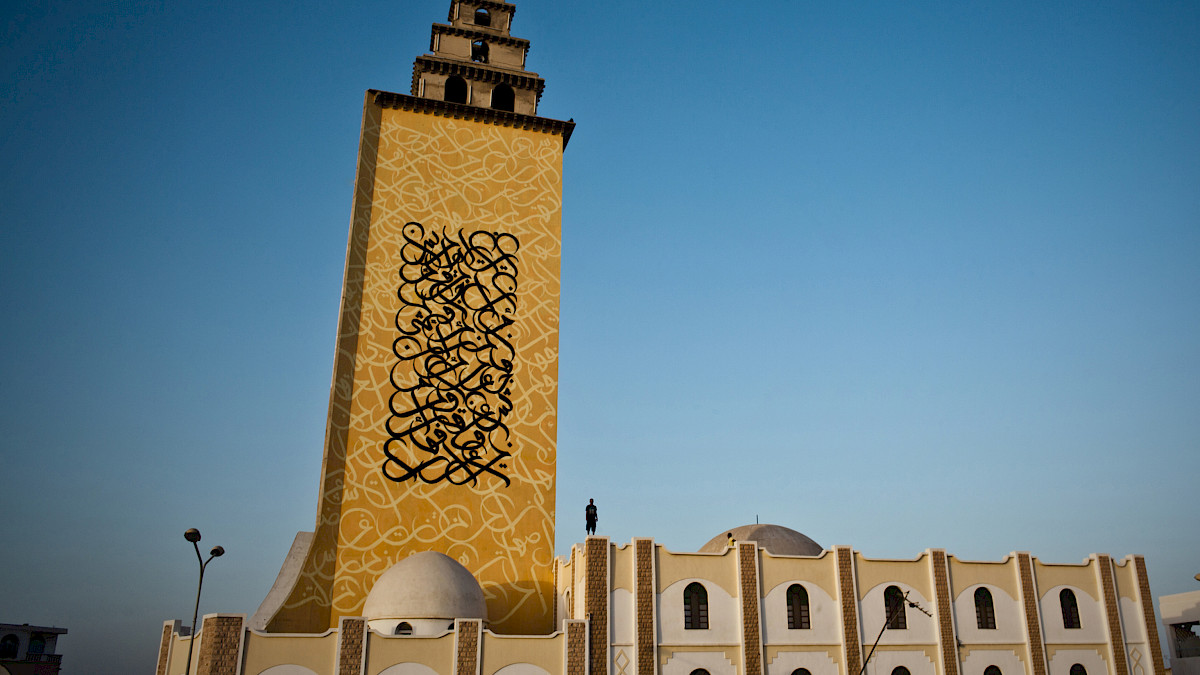
The spatial dynamics were difficult to overlook during the 2011 movements of revolt in Tunisia, pushing the damned in the center of public attention in the concerted effort of turning prevailing authoritarian politics inside–out. Venturing in the spatial contestation central in these revolts, the mesmerizing occupation and re-appropriation of symbolic places, such as the Kasbah Square or Bourguiba Avenue took center stage. These movements of occupation and re-appropriation of spatial power produced momentous heuristic enclaves of another order, projecting dreams of a renewed inclusive free and dignified body politic. Based on a long-term research in the field of visual arts in Tunisia between 2011 and 2017 and the combination of various postcolonial critiques, this article demonstrates the way in which violent processes of destruction preceding these processes of re-appropriation and occupation are too often overlooked. Police stations, the presidential personality cult and the private estate of the authoritarian regime are identified and treated as spatial nodes that maintain the compartmentalization and fragmentation of urban space in place. Moreover, by including in the analysis the often-omitted Islamist occupation and re- appropriation of mosques and public space contesting the ongoing constitutional political dynamics, this article elucidates why the revolutionary process failed in the production of a long aspired liberated and dignifying space, as the revolutionary re-appropriation of these symbolic nodes of power was not included in any political agenda.

La naissance d’une pensée et d’une pratique-autre en Tunisie post-révolutionnaire

01-07-2021
Papers
Malek Gnaoui
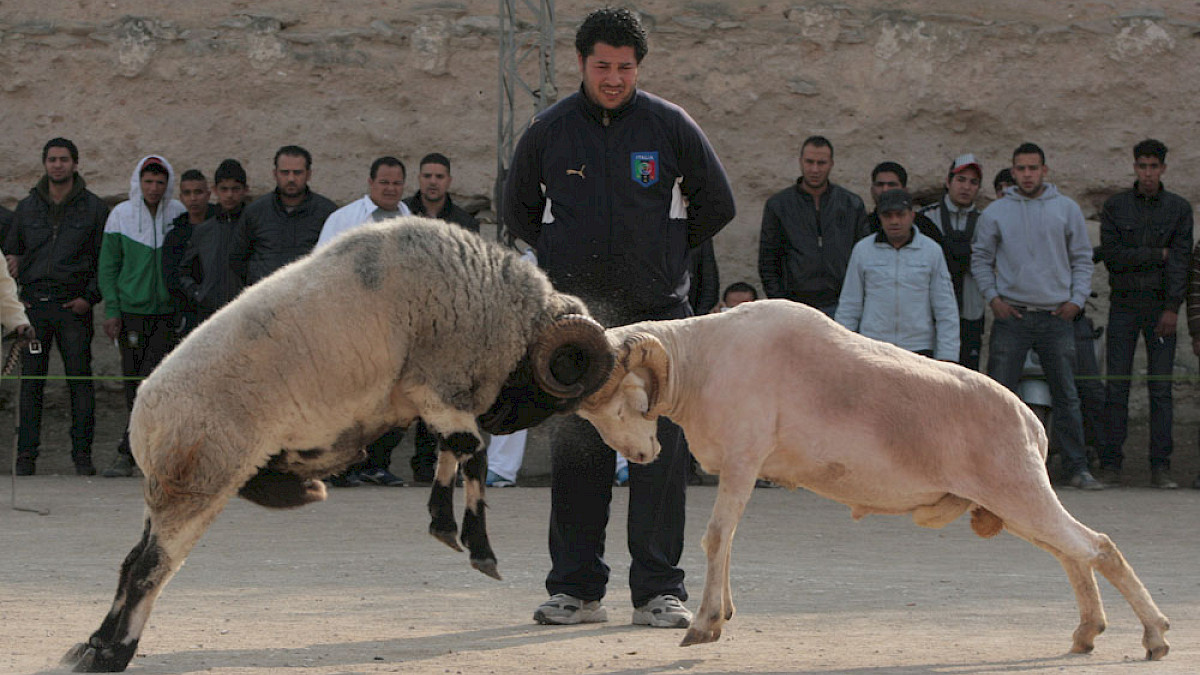
Dans un premier temps, je voudrais approfondir la figure du mouton noir dans l'œuvre de Malek Ganou, et ceci en relation avec un contexte politique précis : les diverses controverses liées à la relation tendue entre une liberté nouvellement acquise et les collectivités militantes islamistes fraîchement constituées – ce qui interroge les limites du sacré dans l'espace public. Dans un second temps, j’examinerai la performativité de l'installation vidéo mobile Dead Meat Moving et sa relation au geste du sacrifice, en réimaginant le mouton noir à travers la figure du corps précarisé et étouffé des damnés de l'histoire tunisienne, trop souvent réitérée dans la figuration du harrag, martyr ou djihadiste, trois subjectivités sacrifiées aux frontières globales de la postcolonie. Ensuite, j’analyserai le Black Show, qui illustre parfaitement ce qu'Abdelkebir Khatibi1 appelle une double critique, nécessaire pour affronter des constellations politiques complexes et violemment conflictuelles. Enfin, je rapproche les deux éléments du diptyque, non pas pour condamner le jeu populaire des combats de béliers, ni le rituel religieux candide et profondément significatif mais, bien au contraire, afin de démontrer comment, dans leur composition performative, Dead Meat Moving et le Black Show ont réussi à transformer ce qui est désapprouvé, marginalisé et désolé, en ce que Homi Bhabha appellerait un tiers-lieu critique et sensible, permettant l’apparition non seulement d’une pensée- autre, mais aussi d’une pratique-autre post-révolutionnaire trop souvent réduite au silence et donc inouïe. Un Chapitre publier dans le livre Attaques # 3. (2021, p.323-343)
Mohamed Bourouissa- Brutal Family Roots (c) Selma Gurbuz

Meandering in a Land of Selfless Love

30-06-2021
Articles
Hasselt
Algiers
Martinique
French Guiana
Mali
Silvia Franceschini
A walk through the exhibition “Le Déracinement. On Diasporic Imaginations” In spring 2021, Z33 – House for Contemporary Art, Design & Architecture in Hasselt, Belgium hosted the exhibition Le Déracinement: On Diasporic Imaginations. Curated by Silvia Franceschini and including work by artists Mohamed Bourouissa, Kapwani Kiwanga, Raphaël Grisey & Bouba Touré, Mathieu Kleyebe Abonnenc, Fatma Bucak and the Otolith group, the whole visual dispositif of the exhibition was centered around French sociologist Pierre Bourdieu’s photographic work, produced in Algeria between 1958 and 1961.  Upon visiting, I wondered how an exhibition revolving around the photographic work of a sociologist such as Bourdieu might relate to intrinsically colonial dynamics of uprooting and displacement. But also how a curator operating in an art institution such as Z33 might relate to such a sensitive and thorny topic as diasporic imagination, in the intrinsic contradiction of showing this work within such a—at times violent—context of an institutionalized museum. Nonetheless, I decided to put that set of questions aside for a moment, and surrendered myself to the challenging winding path set out by Silvia Franceschini. My understanding of the process of uprooting and diasporic displacement eventually turned inside out, moved from the liberated land of Algeria and Mali, via the still colonized overseas departments of Martinique and French Guiana, over the hearth of British Empire through the Black Atlantic to end in contemporary war-ridden Syria.
Sacré Printemps! CHATHA

Kitchen Broadcast: Exiger des transformations historiques quelque part entre le Maghreb, Paris et Bruxelles

17-12-2020
Conversations
Tunisia
Bruxelles
Paris
Nidhal Chamekh
Hela Yousfi
Mohamed Toukabri
Reem Shilleh
Kitchen Broadcast est une émission radio en ligne programmée par Joachim Ben Yakoub et Reem Shilleh. Avec la participation de Hela Yousfi, Mohamed Toukabri et Nidhal Chamekh, ce dîner Kitchen Broadcast propose une réflexion critique sur les remises en question postcoloniales et la promotion de transformations historiques – quelque part entre le Maghreb, Paris et Bruxelles. Il y a précisément dix ans, en décembre 2010, la Tunisie a embrasé le monde. De la Kasbah de Tunis à la place Tahir du Caire, de la plaza del Sol à Madrid à la place Syntagma à Athènes au centre du monde capitaliste de Wall Street, la terre entière était « occupée » par n sentiment d’indignation. Alors que les demandes de liberté ont été aisément satisfaites par des réformes démocratiques cosmétiques, les demandes de pain et de dignité restent lettre morte. Toutefois, l’autoritarisme mondial, alimenté par des violences policières, du racisme et de l’islamophobie paraît progresser, également en Europe. Contrairement à Bruxelles et à Paris, la décolonisation n’est pas (encore) une métaphore au Maghreb. Après près d’un siècle et demi de domination coloniale, six décennies de gouvernance postcoloniale et à présent dix ans de révoltes au Maghreb, les demandes décoloniales peuvent y sembler caduques de prime abord, au mieux anachroniques. Néanmoins leur timide résurgence actuelle dans les discours d’une minorité diasporique témoigne d’une possible reviviscence. Il est grand temps de mener une discussion en profondeur.

Revolting Senses. The contrapuntal Aesthetics of Revolt in Tunisia

21-11-2018
Books
Tunisia
Combining key insights from aesthetic theory and various postcolonial critiques, this research looks into the aesthetics of revolt. Taking the recent and exceptional sequences of revolts in Tunisia as a case study and thus starting from an extensive and unique fieldwork, and by unraveling contrapuntally the complex entanglement of processes of politicization of aesthetics and the aestheticization of politics, revolting senses show how state aesthetics are always historically formed and how the sensible, or that what can be seen, imagined or embodied, is consequently shared, divided and distributed, but also how accumulated aesthetic agency can question and possibly alter this shared distribution in times of revolt. This study apprehends revolt in a phenomenological way as a lived, embodied and visual experience and thus as a process of diversion or reappropriation of spectacular power. It contends that revolt has the potential to alter a given police order. Nevertheless, the often too precipitated contentions that the moving body politic would have radically altered the order of the sensible, during the latest sequences of revolt in Tunisia, is altogether tempered. This dissertation points at the intricacies that accompany the processes of revolt against a firmly seated police order, especially the difficulty of creating different conditions of intelligibility and possibility that entail a fundamental transformation of what appears to sense experiences. These particular intricacies could somehow have been foreseen as aesthetics was explicitly grasped as a historically formed contrapuntal ensemble or as an all-encompassing realm that is made of different intermeshed, overlapping, and mutually embedded histories traversed by a colonial divide.

Performing Self-sacrifice, Despite Everything or Despite Oneself?

04-10-2018
Papers
Fanni Roghman Anni
Danceurs Citoyens
The authoritarian regime in Tunisia can be defined as an intensive bio-political regime where disciplinary techniques of surveillance and governmentality are entangled with sovereign logics of exceptionality and decisionism. Authority and power is woven through every aspect of everyday life and to exceptional instances of the power over life and death. Within a bio-political imperative, the body must constantly be managed, governed and controlled. The body is therefore at the same time the strongest medium to enact protest. In this light, we can read the self-sacrifice of the different martyrs during the liberation phase of revolution as a potent symbol of disruption of the expected cooperation of the body within bio-political power that allowed for the appearance of the people in all its complexity and diversity, including the life of the most disenfranchised. Comparing the performances of Fanni Roghman Anni and Danseurs–Citoyens, two different collectives that emerged during the revolution, the performance of self-sacrifice will further be analyzed as a condition for the coming into being of a necro-political space of appearance. Not only the bodies in the street but additional embodied artistic performances during the constitutive phase of the revolution produce extra-discursive effects outside the bio-political logic, that allowed to further engage in fundamental ethical question in the future constitution of new post-revolutionary body politic. Published in the volume edited by Gržinić Marina and Aneta Stojnić, Shifting corporealities in contemporary performance: danger, im/mobility and politics. (Springer, 2018: pp 251–274)
Selma @ Sofian Oussi - Here(s)

The Dream Collaboration

07-07-2018
Articles
Tunisia
Bruxelles
Selma Ouissi
Sofiane Ouissi
The online dance performance Here(s) of the inseparable artist duo Selma and Sofiane Ouissi took place in October 2011 during the opening of the Meeting Points 6 festival, an initiative of the Young Arab Theatre Fund. Sister and brother Sofiane en Selma gradually formed - from one performance to the next - a single body through their shared practice as dancer and choreographer, until Selma moved to Paris and Sofiane was left alone in Tunis. Thanks to real-time video communication applications, they managed to bridge the distance between both metropolises and thus found a way to reconstitute their shared practice and reflection. During Here(s) they share this initially rather practical communicative bridging, which gradu- ally grew into a full-fledged choreography. In what follows we will delve deeper into the question how this performance touches on the essence of current global challenges in a clear, refined manner. Subsequently, the Meeting Points festival, in which this performance took place, will be seized in order to linger on the necessity to review existing practices transnationally, to anchor them sustainably and lastly, to interweave them from below with other relevant local diasporic practices. Throughout this exercise I hope to touch upon possible pitfalls in setting up collaborative relations with the MENA region from the privileged position that the capital of Europe, at least for now, still enjoys. The main challenge will be to understand the apparent contradiction between different types of global and local dynamics and thus to discern the importance of their inevitable entanglement and to take into account its political implications. A necessary exercise, certainly now Tunisia is included in the Creative Europe programme

Moving Bodies in the Streets of the Heart of Tunis

15-10-2015
Articles
Sofiane Ouissi
Selma Ouissi
Tunisia 2014, almost four years ago, the people took the street and sent the autocratic ruler packing in the direction of Mecca. The performativity of bodies in the street in all their plurality laid claim and occupied the symbolic public space of the Kasbah, forming a collective body defying the established body politic, until the demand of the dissolution of the political structures in power was met. Four years later life regained a semblance of normality. However, the sudden historical transformation brought the political back in the center of the public sphere and encouraged dancers and performers to sporadic reinvest public space. The altered political context makes visible key political aspects and conditions of embodied artistic performances in the public space. By closely analyzing different cases of bodily interventions in public space, we hope to strengthen our understanding of the political role performances can play in a revolutionary context.The findings further elaborated in this article are mainly based on an intensive participatory observation during a Euro-Mediterranean artistic training late in 2014 in Tunis, organized by the Fai-Ar, the European Center for Artistic Training in Public Space and the L’Art Rue Association, initiator of the Dream City Biennial of Contemporary Art. The research-oriented but practice-based training was initiated in the local context of Tunis’ medina on the theme of “Conflicts and Resistance: The Artist Citizen and the Tunisian Public Space”. Artists studied public space in its relation to pictures and images, materiality, voice and sound, dramatic writing and staging, the body and movement. As I did in my participatory observation, in this article I focus on the body and movement in public space. I will gradually develop my argument relying on my lived, embodied and shared experience with other participants of three illustrative performances initiated during the artistic training.

Superdiversiteit en Democratie

30-01-2014
Books
Bruxelles
Antwerpen
Gent
Ico Maly
Jan Blommaert
Vertrekkend vanuit onderzoek naar en in stadswijken concluderen de auteurs dat zelfs de vlag ‘multiculturele maatschappij’ tekortschiet om de diversiteit van de hedendaagse samenlevingen te begrijpen. ‘Vlamingen maken na 22 uur geen lawaai meer. Ze spreken Nederlands, zijn punctueel en vinden gezondheid heel belangrijk. De Vlamingen leven niet op straat, ze houden van rust en stilte.’ Zo schetste de Vlaamse overheid in zijn legendarische ‘starterspakket Inburgering’ het beeld van ‘de Vlamingen’. Zouden er vandaag nog mensen rondlopen die deze karikatuur ernstig nemen? Vertrekkend vanuit onderzoek naar en in wijken in Brussel, Antwerpen en Gent concluderen Ico Maly, Jan Blommaert en Joachim Ben Yakoub dat zelfs de vlag ‘multiculturele maatschappij’ tekortschiet om de diversiteit van de hedendaagse samenlevingen te begrijpen. Door toegenomen mobiliteit, globalisering en het internet is de wereld en ieders leven grondig veranderd. Daardoor moeten we onze democratie herdenken, verbeteren en verdiepen.  Ico Maly is doctor in de cultuurwetenschappen, coördinator van Kif Kif en gastprofessor aan het Rits. Hij schreef o.a. N-VA. Analyse van een politieke ideologie (EPO, 2012).Jan Blommaert is hoogleraar taal, cultuur en globalisering aan de universiteiten van Tilburg en Gent. Hij publiceerde o.a. De heruitvinding van de samenleving (EPO, 2011).Joachim Ben Yakoub is stafmedewerker beeldvorming en diversiteit bij de Pianofabriek in Brussel en doctoraal onderzoeker bij de Middle East And North Africa Research Group.