Playful Dogmatism
Playful Dogmatism
Milo Rau and Joachim Ben Yakoub in Conversation
Sebastien Henderikx, The Theatre Times, 7th Oct 2018
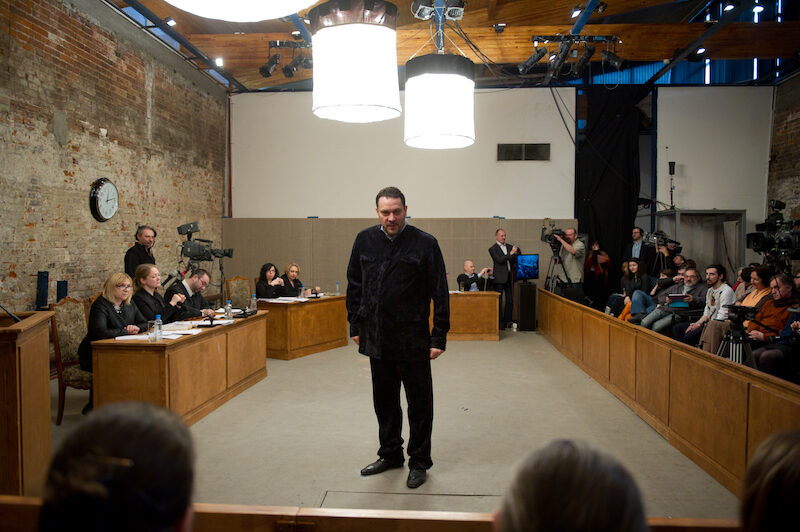
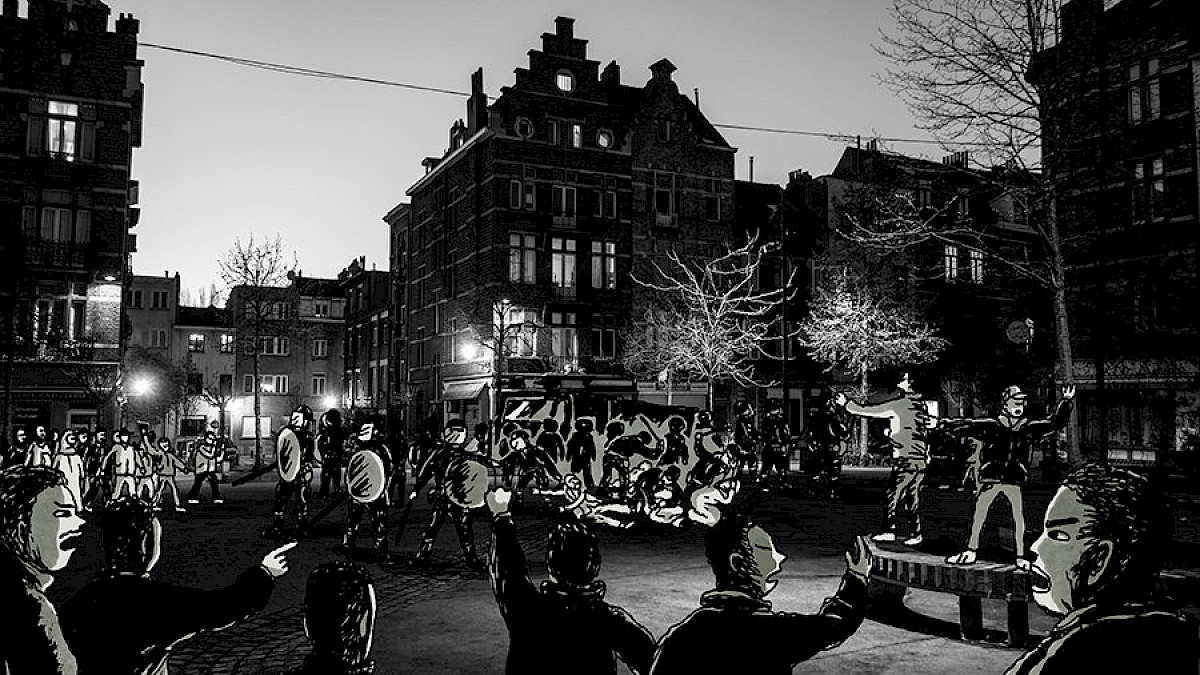
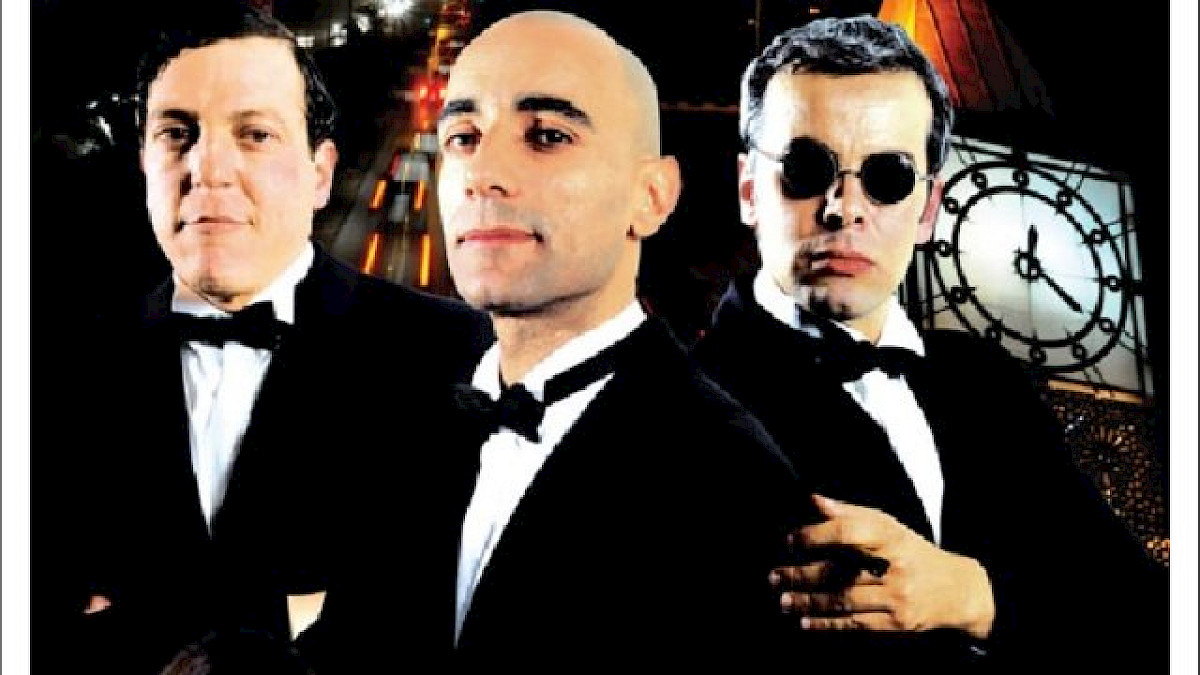
"The Moscow Trials" © IIPM and Maxim Lee
Milo Rau and Joachim Ben Yakoub in conversation on the Ghent Manifesto.
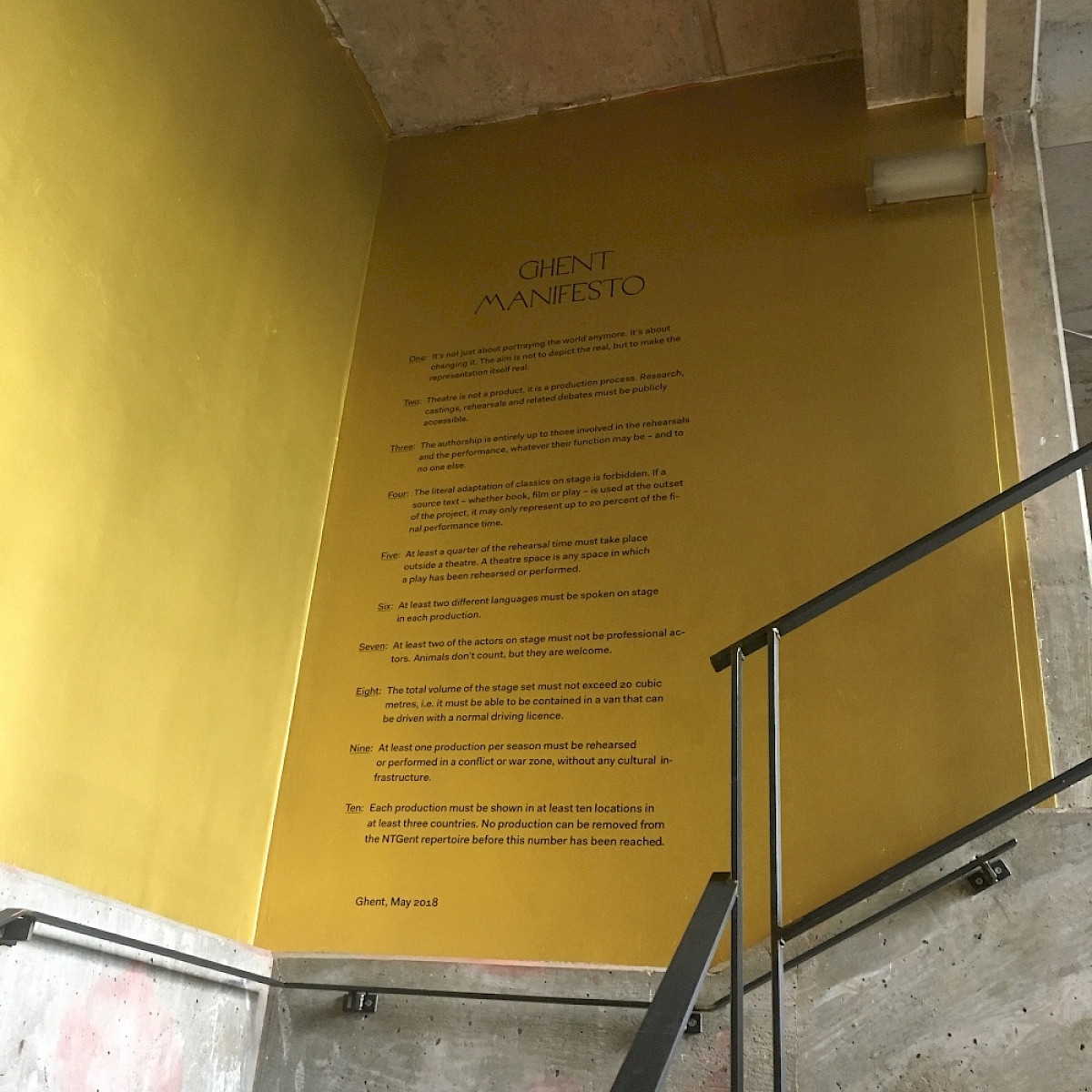
In May NTGent published the Ghent Manifesto. Inspired by the groundbreaking Dogma 95-Manifesto for film, it consists of ten rules the artists who’s work is produced by the city theatre, will have to follow–or at least relate to–from now on. NTGent-director Milo Rau and doctoral researcher Joachim Ben Yakoub discuss some of the restrictions mentioned in the manifesto.
“It’s like dancing with handcuffs.”
The two men meet in the building of the Flemish radio and television broadcasting organization VRT, where Milo Rau is invited for a primetime talk show. Since he recently became the artistic leader of the Ghent city theatre, the renowned Swiss director hasn’t suffered from a lack of media attention in Flanders. The public call for an ex-Jihadi fighter to participate in a theatre project based on the 15th century Van Eyck-altarpiece The Adoration Of The Mystic Lamb generated quite some uproar. And La Reprise, his first production for NTGent dealing with the homophobic murder of Ihsane Jarfi in Liège, was critically praised. Joachim Ben Yakoub is on course to finish his doctoral thesis on the aesthetics of recent upsurges of revolt in Tunisia, and recently co-edited a highly debated issue of the cultural magazine Rekto: Verso on the decolonization of the Flemish cultural field. He feels critically challenged by Rau’s artistic practice and some of the rules in the Manifesto.
ETC: Why did NTGent create these rules?
Milo Rau: One of my aims was to open the city theatre to the independent scene and to touring. I also want us to work with nonprofessional actors, not only with the twenty Flemish actors everybody knows. I have learned that the Belgian theatre system is a bit more adaptable to the rules than the French or German systems.
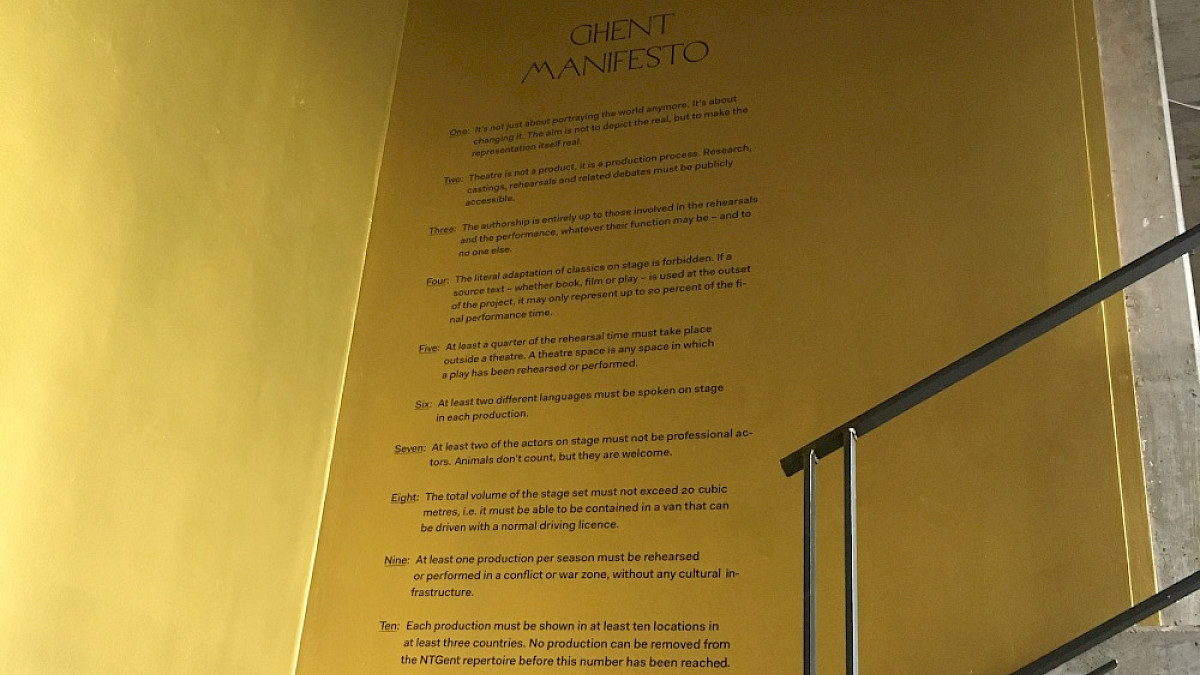
1. It’s not just about portraying the world anymore. It’s about changing it. The aim is not to depict the real, but to make the representation itself real.
ETC: Is the manifesto more of a reaction to those systems than to the Belgian or Flemish one?
M.R.: Yes. Let’s have a look at the rule about the text for example. (Rule four: “The literal adaptation of classics on stage is forbidden. If a fixed text–whether book, film or play–is available at the beginning of the rehearsal, it may not exceed 20 percent of the performance period,” ed.) To rewrite existing texts during rehearsals is quite normal in Belgium, but in Germany or France, you normally use the Schiller or the Molière as it was written.
Another reason why I chose to create this manifesto is related to institutional politics. Everywhere you are as an artist there are rules present, but mostly only implicitly. As a political thinker, I feel the need to make them explicit. I think there wasn’t one single movie that followed all ten of the Dogma 95-rules. It’s not my aim to be dogmatic but to open the discussion.
“Everywhere you are as an artist there are rules present, but mostly only implicitly. As a political thinker, I feel the need to make them explicit.” (Milo Rau)
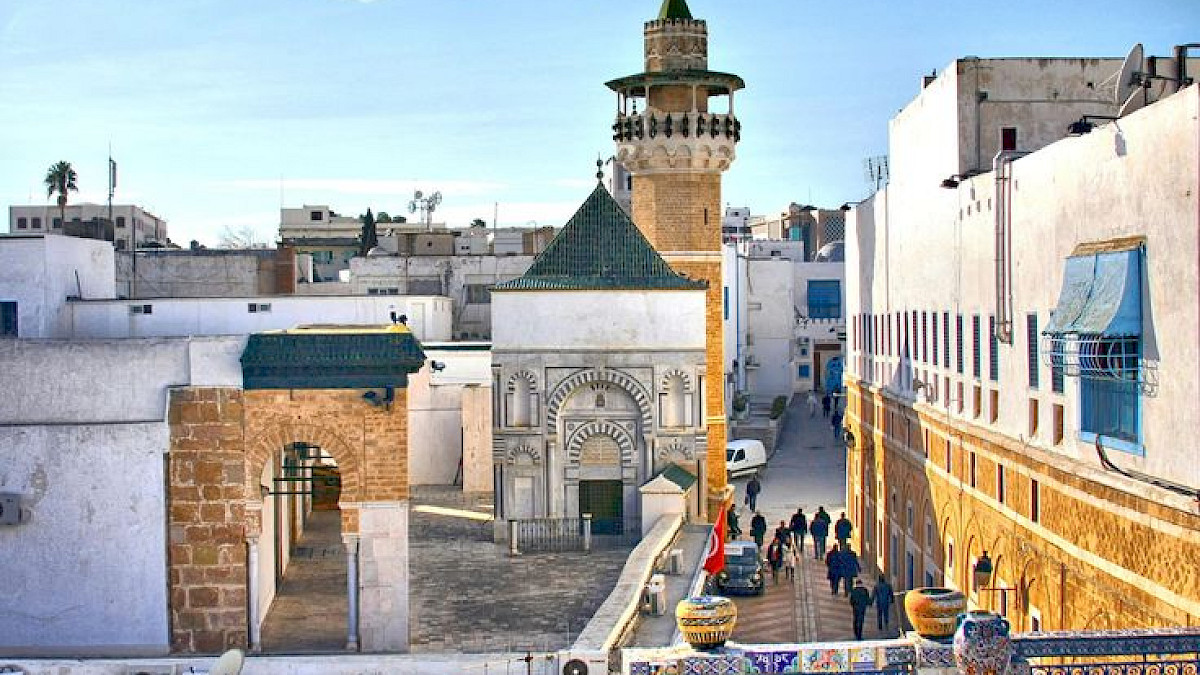
Joachim Ben Yakoub: It can indeed be confusing how the gatekeepers of cultural institutions hold their dogmas behind their backs. By presenting the rules of NTGent explicitly, you’re however making an authoritative statement. Another strategy would be to communicate you use specific dogmatic rules, while not making them public. The people working in the theatre would only discover them incrementally. This strategy was adopted by Dream City, a festival in Tunis, which could be an inspiring case when thinking about the connections between a city theatre and the ongoing dynamics of a city. The dancers-choreographers Selma and Sofiane Ouissi started it as a collective performance in public space, meant to subvert the spectacle of the authoritarian regime of Ben Ali–five years before the revolution in 2011! Gradually it grew into a contemporary art festival taking place in the old city center. When I visited Dream City and talked to its artists and directors, I was told how important it was to follow “the protocol.” I looked everywhere, but couldn’t find that protocol! (laughs) It seemed to be something relational: the rules could change each time Selma and Sofiane had a discussion with the artists, researchers, or audience members.
M.R.: I can understand that under more or less classical dictatorships, you try to convert the idea of the protocol. I see the late capitalist or neoliberal world I live in as a non-dogmatic one, in the sense that the dogmas are not known. But they exist.
ETC: How do the artists NTGent will work with reacting to the restrictions of their artistic freedom?
M.R.: We discussed it. They all understand that it’s about structural change. The manifesto also restricts my own practice by the way. I often mix professional actors and non-professionals. (Rau refers to rule seven: “At least two of the actors on stage must not be professional actors. Animals don’t count, but they are welcome,” ed.) But sometimes I like to work with professionals only. Well, that’s over for now: no elitist casts anymore!
The manifesto is more about changing the institution than changing the arts. Rule number ten, for example, is especially difficult for NTGent: “Each production must be shown in at least ten locations in at least three countries. No production can be removed from the NTGent repertoire before this number has been reached.” This means we have to try and find places for our productions, even if they turn out to not be so popular. I know the whole apparatus of NTGent thought when reading this: “Oh, shit.” The rules pose difficulties for everyone involved. The Brazilian artist Christiane Jathaly put it like this: “The Ghent Manifesto, it’s like dancing with handcuffs.”
2. Theatre is not a product, it is a production process. Research, castings, rehearsals, and related debates must be publicly accessible.
ETC: Several years ago Benjamin Verdonck wrote an ecological manifesto in which he invited the Flemish performing arts field to follow a set of rules reducing their carbon footprint. Some critical voices argued it tried to impose Verdonck’s own aesthetics on the rest of the field. Couldn’t we ask the same question in the case of the Ghent Manifesto?
M.R.: The manifesto is not about aesthetics, it’s about structures. Indeed, it’s totally what we would like to see at NTGent, how we think we should change the institution and the self-image of a city theatre. It’s our point of view, as spectators, as members of the theatre system. I know there are lots of other interesting points of view, but again: they can only be explicitly discussed when we are explicit ourselves.
3. The authorship is entirely up to those involved in the rehearsals and the performance, whatever their function may be–and to no one else.
ETC: Joachim, I’m curious to hear what you think about rule number three: “The authorship is entirely up to those involved in the rehearsals and the performance, whatever their function may be–and to no one else.” I know you are critical of the idea of individual authorship.
J.B.Y.: Indeed, I believe the role of the individual artist-as-author is often overestimated. How much of what is being said, written, or played comes out of the mouth or pen of a single artist? Most of what we can think and imagine is a priori caught in an interpersonal web and mediated through a shared language system. Especially, when their work deals with sensitive social topics, artists need to think beyond their own ego in function of a group that is collectively and violently targeted.
Focusing on the individual author also has major consequences for the reception of an artwork. Often the name of an artist defines its perceived value more than the work itself. Most people came to Kunstenfestivaldesarts to see the newest piece by Milo Rau, not to see La Reprise, a docu-theatre play on a homophobic murder that counters prevailing islamophobic prejudices, or a formal critique on the dramatic form central in the Western canon. They will also come to NTGent because of Milo Rau. The author is a key figure in the hyper-competitive context we live in. Likewise, when there is a new production or a controversy in KVS (the Flemish city theatre in Brussels, ed.), Michael De Cock gets invited to VRT to talk about it, while the strong team of city dramaturgs tries to work against the grain of the centralized structure of a city theatre. Unfortunately, the name of the often white male director tends to make the collective contributions invisible.
How far are you willing to go in order to sacrifice the author? Could the city co-author or co-direct the city theatre? You could, for example, think of a dogma stating that at least one production a year should be directed by the city of Ghent.
“Often the name of an artist defines its perceived value more than the work itself.” (Joachim Ben Yakoub)
M.R.: That’s a good suggestion, but it’s a long way to go before the idea of the single author will be sacrificed. In the Europe Trilogy (The Civil Wars, The Dark Ages, and Empire, ed.) there is no single word of mine. The texts were based on interviews with the actors–coming from 13 different countries–and rewritten together with them. When I was nominated for the prize for the best play in the German-speaking world, the jury had a harsh discussion. They decided they couldn’t give the prize to me because I hadn’t written the text myself. I answered: “that’s true, I was only the stenograph. So give your prize to all of us, to the whole team.”
Most of the texts for La Reprise were the product of improvisations by the actors. The authors’ rights go to all of us, including the sound and light technicians, the production manager, the research assistant, and so on. But emancipation can also be hard. For some actors, it’s quite stressful not to know what they will be doing at the beginning of every rehearsal for example. And for the technicians, it’s not fun to be present at all those collective try-outs.
4. The literal adaptation of classics on stage is forbidden. If a source text–whether book, film, or play–is used at the outset of the project, it may only represent up to 20 percent of the final performance time.
ETC: Could we say this is also more of a reaction to the German or French system? In Flanders, actors emancipated themselves more than twenty years ago. Are you proposing a mixture between the model of the theatre director and the one of the actors collective?
M.R.: I think the way the Flemish actors collectives work is that they are normally staging Western classics. But in my opinion, it’s not enough to push out the director, you also have to push out all these texts. We can’t go on with formulating this postmodern excuse that a text becomes somehow yours when you embody it. I like karaoke, but we should also produce new music, no? In season 2019-20 we invite the actors collective De Roovers to work with the theatre text I personally hate the most: The Visit Of The Old Lady by Dürrenmatt. But actually, I’m more interested in Sara De Bosschere from De Roovers fighting with the violence of the actual capitalist society in La Reprise instead of another piece repeating a “bourgeoisie would do everything for money-story” written in the 50s.
I know, this idea of a tabula rasa, and that an artist has to work on everything, is a bit romantic. That’s why I’m for multifunctional collectives. It’s too hard for one person or one department alone. Here the director comes back into play, as a stenograph, a sparring partner, a kind of trainer, whatever.
In Flanders, Goethe and Dürrenmatt may seem to be exotic guys from Germany, but actually, they’re just a clever choice because people know their names. I remember, when I was a young director in the beginning of my twenties, I was about to stage a play which included one single sentence by Goethe. I had written the rest of the text myself, but they asked me: “Can’t we write ‘nach Goethe’ on the poster?” They knew Goethe would sell, and Milo Rau wouldn’t. I liked that pragmatism, and replied: “Okay, but let me include another sentence so we can write ‘nach Hitler’–that would sell even better!” (laughs) This is the system I come from.
“I think the way the Flemish actors collectives work is that they are normally staging Western classics. But in my opinion, it’s not enough to push out the director, you also have to push out all these texts.” (Milo Rau)
J.B.Y.: I would like to return to the question to what extent the dogmas of the city theatre are echoes of your artistic work, thereby focusing on rule number nine (“At least one production per season must be rehearsed or performed in a conflict or war zone, without any cultural infrastructure,” ed.). What does it mean to translate the vision of IIPM (Milo Rau’s International Institute of Political Murder, ed.) to an institution like NTGent? In my view, IIPM succeeded to create a sophisticated “empathic machine” which can be transposed globally. If I play the devil’s advocate, I could state that machine can almost randomly translate local political controversies into universal plays, which are highly competitive on the international performing arts markets. IIPM already traveled to Rwanda, Romania, Russia, Congo… What does it mean to transform this machine into ten dogmas for a city theatre, and how does that relate to the ongoing local artistic dynamics in the city of Ghent?
I’m slightly worried a part of the problems with the previous artistic team (headed by the Dutch director Johan Simons, ed.) could be repeated. Simons wanted NTGent to be a theatre “in the middle of the city, in the middle of the world,” but focused on the world and forgot the city. I believe the challenge for a city theatre today would be to bring the city into the theatre as a form of compensation or reparation. There is an urgent need to catch up with recent urban developments.
5. At least a quarter of the rehearsal time must take place outside a theatre. A theatre space is any space in which a play has been rehearsed or performed.
M.R.: I think the main problem with Johan–and the management–was that they wanted to use NTGent like a big German city theatre. But it’s not that kind of machine. NTGent is a pirate vessel instead of a big ship. We can produce a lot, but there are limits: creating bourgeois theatre–combining random classical or pop music with a random dramatic text of the Western tradition, performed by a star ensemble–is materially not possible for us. We only make eight house productions next year. If we would want to produce one big musical à la Ivo Van Hove, we would have to kill three other projects.
We work with local actors like Victoria Deluxe, Action Zoo Humain, Miet Warlop, and Lies Pauwels. We set up a whole workshop program with the university and the art school. On the other hand, we invite international artists like Faustin Linyekula for example, whose work we like a lot and who has a special relation to this globalized “empathic machine,” you could say.
What’s interesting about Ghent: it’s a small city. You can invite the different “milieus.” That’s what we try to do with the Lam Gods-project (based on the Van Eyck-altarpiece The Adoration Of The Mystic Lamb, ed.). In order to achieve this, you have to go out into the city. I think in my theatre work I always try to be popular at some level. I want to be understood. I want discussions, discussions like this one. And because I’m used to “land” somewhere, I need local experts. When working in Russia or Congo for example, I don’t know the traditional law. So I need to invite lawyers, I need to go outside of the theatre and then bring back what I found to show it to an audience. By going out, you can attract other kinds of audiences than the usual theatre public. Hate Radio (a piece dealing with the role of Radio Mille Collines in the Rwandan genocide, ed.) attracted a lot of people from the Rwandan and Congolese diaspora for example. That’s what I miss in the independent scene, if you ask me. It’s quite solipsistic.
6. At least two different languages must be spoken on stage in each production.
J.B.Y.: Indeed, with the Lam Gods-project you work in and with the city, but starting from a historically fixed and canonical representation–not from the existing relational dynamics. Nevertheless, I believe it’s a beautiful way to start the new season of a renewed city theatre: to theatrically re-present an ancient and complex representation of the city of Ghent.
ETC: I would like to hear your thoughts on the first rule, Joachim, from the perspective of your doctoral research on the aesthetics of revolt in Tunisia. The rule expresses a belief in the socially transformative potential of theatre: “It’s not just about portraying the world anymore. It’s about changing it. The aim is not to depict the real, but to make the representation itself real.”
J.B.Y.: A revolution starts with the sudden, almost unmediated emergence of the real. People are pushed into a collective performance by a collective drive. They put their bodies in danger, risk death in order to change society. It’s a spontaneous destruction of the symbols of that world they are held hostage in. There is no director writing the script, but in hindsight, you can recognize a certain dramaturgy of this emergence of the real.
And of course, you always change the world, even with the smallest revolt, with every single piece of theatre you make. I would even say it is impossible not to change the world while engaging artistically with your surroundings. But when you say it’s about making the representation itself real…That seems difficult. You can’t escape representation in the black box of the theatre, no?
7. At least two of the actors on stage must not be professional actors. Animals don’t count, but they are welcome.
M.R.: Sometimes you can. I mean: what is a revolution? A revolution is a performance that becomes real. Let’s take the first French parliament for example. The Third Estate said: “We unite now, and we’re the nation.” Then they really became the nation, and the king was killed. It became real, in a horrible way, but it became real. They used Roman clichés. They reenacted the Roman Republic to give shape to a modern, national state. So actually, it works. You can symbolically invent reality.
ETC: With the Congo Tribunal you have set up a fictional tribunal for a real crime case in Eastern Congo, with some of the real stakeholders present in the “courtroom.” The project contributes to an existing political struggle. I wonder how the engagement of the outsider, the visitor, relates to the engagement of the resident–like Tunisians in the streets fighting for their rights for example. Aren’t many of the political struggles western artists engage with “second-degree struggles,” the struggles of others?
M.R.: I think that in a globalized world there are no more “struggles of others.” If I go to Congo, the West is there: the multinationals, the World Bank, the big NGOs and so on. Perhaps it’s romantic, but there is not only exploitation. There is also something like solidarity. And responsibility. Our wealth and our peace are based on an ongoing process of externalization and exploitation. Switzerland wouldn’t survive one single week if it were taken out of the Global Market.
The first Congo Tribunal was somehow utopian, but a very real experiment in solidarity. As a consequence, the Minister of the Mines and the Minister of the Interior were dismissed. Now, we’re engaged in a campaign creating ten new tribunals in ten different towns in Eastern Congo, until the institution that is needed–an international court for an economic law–exists in reality.
“I think that in a globalized world there are no more ‘struggles of others.’ If I go to Congo, the West is there: the multinationals, the World Bank, the big NGOs and so on.” (Milo Rau)
J.B.Y.: I know of many young Belgian artists who went to Congo or Palestine as a kind of pilgrimage. Apparently, they don’t feel the urgency of politics closer to home. Only in the Global South can they reinvent their artistic practices.
For me, art or theatre always has to start from your own relation to the conditions and topics you deal with. A lot of people tend to neglect their own positionality when setting up projects abroad. Of course, ultimately it’s about transcending your own subjectivity and touching a universal string.
8. The total volume of the stage set must not exceed 20 cubic metres, i.e. it must be able to be contained in a van that can be driven with a normal driving licence.
M.R.: I think the important thing is the reality of solidarity: what happens in the period you’re preparing an art piece. A project like the Congo Tribunal is not just existing in the moment. The preparations take you two years, and in those two years, you meet people a hundred times. You spend months together. It becomes more than an art project. You could compare it to a love relation. It’s not just you and someone else. It’s about your common struggle. You feel you have an obligation together. In the end, you understand how related we all are.
That’s why I find the continuation of a project important: making a second and third and tenth tribunal, making new versions of older productions, etc. I also like to collaborate together with the same actors over and over again. That’s also a beautiful aspect of working for a city theatre: you have a group of more or less hundred people you continue to work with over a longer stretch of time.
9. At least one production per season must be rehearsed or performed in a conflict or war zone, without any cultural infrastructure.
ETC: Some of the rules seem to generate possibilities to open up the city theatre to a more diverse range of collaborators and visitors. The rule about the languages spoken on stage for example (Rule six: “At least two different languages must be spoken on stage in each production,” ed.), or the one about non-professionals (Rule seven: “At least two of the actors on stage must not be professional actors. Animals don’t count, but they are welcome,” ed.).
J.B.Y.: I question the idea of “non-professionals.” It’s often one of the cards the institutional gatekeepers hold behind their backs. When are artists and their work considered “professional?” How do we define “professionalism” and “artistic quality?” Nowadays, the means of artistic production are more than ever decentralized because of digitalization. As an autodidact, you have the possibility to learn and do it all by yourself, without art school or even without other art institutions. You create your own professional environments and online distribution platforms. What’s happening within these more informal circuits is often not recognized by institutions. But these artists also have the right to the infrastructure and financial means a cultural institution can provide.
When so-called “non-professionals” are included, it’s often difficult to bypass the social reasons why they are there: they have a lived experience of social exclusion, come from a marginalized neighbourhood, etc. Most of the time they have to play their own condition in a more authentic way than a “professional” actor would be able to do. How do we get beyond this?
“I question the idea of ‘non-professionals’. How do we define ‘professionalism’ and ‘artistic quality’?” (Joachim Ben Yakoub)
M.R.: In La Reprise there is a moment where the star actor Johan Leysen and a non-professional performer, a dog-sitter in real life, sit together, telling a story–both of them naked. They don’t do it once but a hundred times, all over the world. For me, this is depicting a romantic, perhaps utopian reality of how you could interact. There is a hierarchy that keeps appearing and disappearing. When we introduced the rule about the non-professionals, Sara (De Bosschere, ed.) was close to your point of view. She didn’t feel well with the fact of having “trophy-non-professionals” in your piece: “they are authentic, they have biographic expertise on the level of social exclusion,” etc.
Can we overcome this if we don’t really work together for a long time? Rule number seven is perhaps the only real aesthetic one: it has to do with a quality of being on stage. When you work several months with a very mixed group of people, the perception and the power relations change. That’s why the castings take so long. I want to work with people who are intelligent on stage, which has nothing to do with the career they had before.
10. Each production must be shown in at least ten locations in at least three countries. No production can be removed from the NTGent repertoire before this number has been reached.
J.B.Y.: I think I miss a dogma where the city can enter, not only as a “non-professional” actor, but as an autonomous and free storyteller. How can the city tell its own stories, from the bottom up? When reading the dogmas I see different possible stories that can relate to the city. But how do we start from the outside, and bring it inside?
I would like to return to rule nine, the one about rehearsing or performing in a conflict zone. There I feel the limits of the globalized empathic machine. Belgium and Ghent are already full of conflict. You felt this conflict when you were searching for ex-jihadis for the Lam Gods-project, right? It generated so much anger and distrust. The past ten years, NTGent was potentially already operating in a conflict zone…
“When reading the dogmas I see different possible stories that can relate to the city. But how do we start from the outside, and bring it inside?” (Joachim Ben Yakoub)
M.R.: The second part of the rule is important: “without any cultural infrastructure.” I found it very valuable to work in Congo, Russia, or North-Iraq. The production process has, for your own team, a pedagogical side. You have to build structures from zero, structures that are just normal to us. You discover what you don’t need. When we presented the Congo Tribunal in Bukavu, there was no cameraman around. It was too expensive to fly in people from Europe, so we started to teach local photographers. They became cameramen and–women, and in the end, they made the Swahili-version of the Congo Tribunal themselves and set up a small tv station. You also create an infrastructure that itself can continue to produce art.
I like the rule, but I know there are many critical questions that arise from it. You are too polite to mention it, but there’s also the question of disaster tourism.
J.B.Y.: Indeed. One could say you instrumentalize a conflict zone for the development of your artistic practice, or pedagogy.
M.R.: Right. And of course you’ve instrumentalized yourself: when we did the Moscow Trials (based on the 2012 trial of members of the activist punk band Pussy Riot, ed.), some affiliates of Putin’s regime used the project to show their tolerant face. The same happened with Kabila’s regime in the Congo Tribunal, but I decided to accept these paradoxes.
It’s also about another way of thinking about internationalization: more democratic, with a focus on the peripheries. The international festival system often produces the total opposite of a real inclusive and diverse perspective. You have the same debates and performances in Tokyo, London, Brussels, Moscow, and Cape Town: a global elite, performing their silly identity problems. When you go and work in Mosul for example, in Central Africa–or in the former mining districts of Charleroi or Liège, or some neighbourhoods in Ghent–there’s the possibility to create something that will perhaps in three or five years time become a real structure…
ETC: Is there a rule missing?
J.B.Y.: I wonder if the empathic machine of IIPM be able to facilitate the stories the city could tell about itself. To facilitate without instrumentalizing them? I’m not sure how I would summarize this in one dogma though. (laughs)
M.R.: That’s the difficulty of making these rules! You have to break your ideas down to a sentence or two, which need to be very clear. It’s like magical thinking. You try to formulate sentences so concrete they will produce the realities they describe. Consequently, you miss a lot of ideological stuff, a lot of “but’s” and “we should also not forget’s.” For the rule you’re trying to propose, we would maybe have to talk several weeks to break it down. But sure, there’s space for rule eleven!
This article first appeared in Etcetera on September 17, 2018, and has been reposted with permission.